Affiliate Disclosure: This article may contain affiliate links. If you sign up through them, CSTechy may earn a commission at no additional cost to you. Our comparisons and conclusions are independent of any affiliate relationship.
Testing & Research Disclosure: This comparison is based on current vendor documentation, official pricing pages, and verified public information as of August 2026. It does not represent first-hand CSTechy testing of every product unless explicitly stated.
Quick Verdict
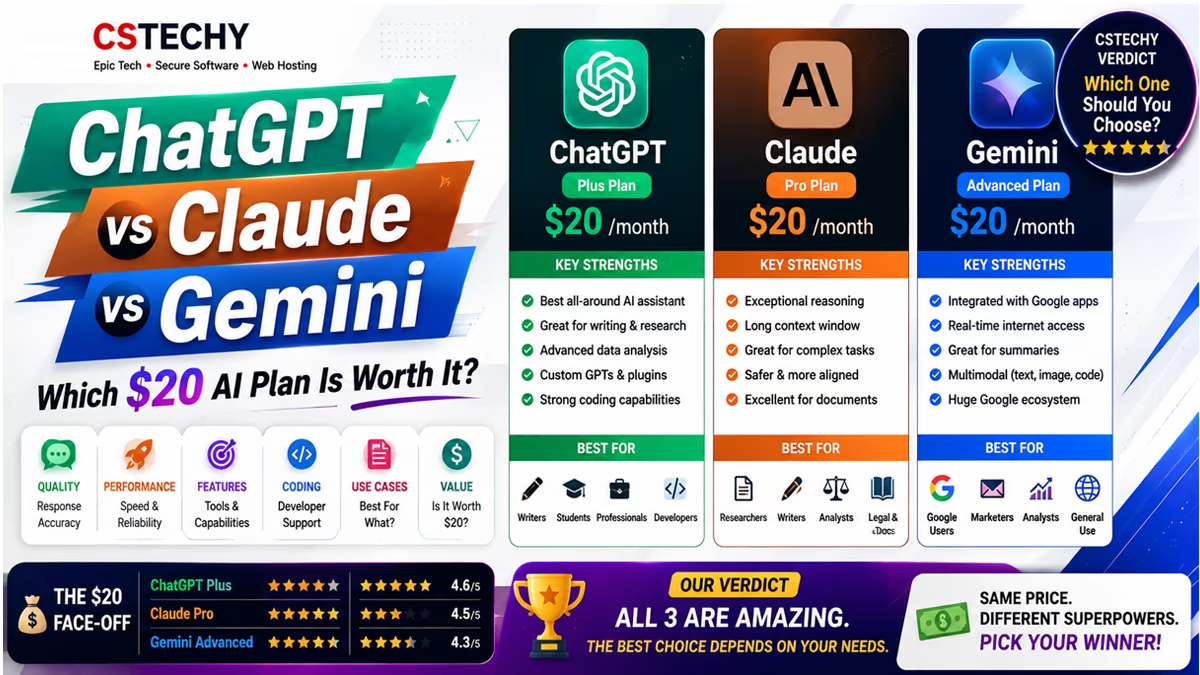
Yes — as of August 2026, ChatGPT, Claude, and Gemini all have an entry-level paid plan that lands right around $20 a month, but the three plans are not interchangeable. ChatGPT Plus costs $20/month, Claude Pro costs $20/month ($17/month if billed annually), and Google AI Pro costs $19.99/month. On paper, that’s essentially the same number three times over. In practice, each vendor has built its $20 tier around a different core strength, so the “best” plan depends heavily on what you actually spend your time doing.
Here’s the short version before the full breakdown:
- Choose ChatGPT Plus if you want the broadest all-purpose assistant — strong writing, native image generation, and Agent-style automation bundled into one subscription with no ecosystem commitment required.
- Choose Claude Pro if your work leans toward long-document analysis, coding, or careful, structured writing — Claude Pro also bundles Claude Code and Cowork at no extra cost, which neither competitor matches at this price.
- Choose Google AI Pro if you already live inside Gmail, Docs, and Drive — the Workspace integration and 5 TB of storage are arguably the real value here, not just the chatbot underneath it.
There’s no single universal winner, and any article that tells you there is one is skipping over how differently these three products are actually used day to day. The rest of this guide breaks the decision down by price, feature set, and use case so you can match the plan to what you actually do rather than to a marketing headline.
ChatGPT vs Claude vs Gemini at a Glance
| ChatGPT Plus | Claude Pro | Google AI Pro | |
|---|---|---|---|
| Entry paid plan | Plus | Pro | AI Pro |
| Price (monthly) | $20/month | $20/month ($17/month billed annually) | $19.99/month |
| Free option | Yes, ad-supported in the US | Yes | Yes |
| Flagship model on this tier | GPT-5.6 Sol | Claude Sonnet 5 (with Opus access) | Gemini 3.1 Pro |
| Strongest use case | All-purpose assistant, image/voice tools | Coding, long documents, structured writing | Google ecosystem, video generation |
| Coding | Strong; Codex access included | Strong; Claude Code included on this tier | Capable; Gemini Code Assist included |
| Writing | Strong, broad-purpose | Strong, especially long-form structure | Solid, especially Workspace-embedded drafting |
| Research | Deep Research included, capped runs | Strong document synthesis | Deep Research with live Search access |
| Multimodal capability | Image generation, voice, limited Sora | No native image generation | Image generation and Veo video |
| Bundled extras | Agent mode, image generation | Claude Code, Cowork | 5 TB storage, Deep Research, Veo credits |
| Ecosystem | OpenAI / broad third-party plugin support | Anthropic / developer-tool integrations | Google Search, Gmail, Docs, Drive |
| Major limitation | Message/feature caps below the $100+ Pro tiers | No native image generation | Reasoning and coding trail the other two on harder tasks, per independent reviewers |
| Best user | Generalists who want one tool for everything | Developers, writers, researchers handling large inputs | Google Workspace households and small businesses |
Pricing Compared
Pricing checked: August 2026. Prices below reflect the US market; regional pricing can differ, and none of these figures should be assumed to carry over to other countries without checking the local pricing page.
ChatGPT. Plus costs $20/month, billed monthly, with no separate annual discount currently advertised for individual subscribers. Below Plus sits a $0 ad-supported Free tier and, in supported markets, an $8/month Go tier that’s also ad-supported and aimed at price-sensitive users who want more volume than Free without the full Plus feature set. Above Plus, OpenAI runs two Pro tiers — $100/month and $200/month — aimed at heavier individual use, along with Business seats that typically run $20–25 per user per month depending on billing term. The spread of tiers is genuinely the most complicated of the three vendors, which makes it easy to compare against an outdated plan if you’re reading an older guide.
Claude. Pro costs $20/month billed monthly, or $17/month if billed annually ($200 upfront, saving roughly $36 a year). Anthropic’s own help-center documentation lists the core Pro benefits as at least five times the usage of the free plan per session, priority access during high-traffic periods, early access to new features, and — importantly — access to both Claude Code and Cowork. Above Pro, Anthropic offers two Max plans at $100 and $200/month for users who outgrow Pro’s usage limits, and Team plans that start around $25–30 per seat per month for organizations that need shared workspaces and admin controls.
Gemini. Google AI Pro costs $19.99/month and includes full access to Gemini 3.1 Pro with a 1 million-token context window, Deep Research, Veo-powered video generation credits, and 5 TB of Google One storage that also applies across Gmail and Photos. A cheaper Google AI Plus tier sits in the $4.99–7.99/month range with a more limited version of Gemini 3.1 Pro and less storage, while Google AI Ultra sits above Pro at $99.99/month and $199.99/month for users who need substantially higher usage ceilings.
The takeaway: all three plans land within a dollar of $20, so price alone doesn’t settle the decision — the usage limits, bundled tools, and ecosystem fit do the actual differentiating.
What You Actually Get for Around $20/Month
Sticker price is nearly identical across all three, but the actual contents of that $20 differ more than the headline numbers suggest.
ChatGPT Plus buys you meaningfully higher message caps than Free, access to OpenAI’s current flagship reasoning model, Agent mode for multi-step tasks like booking research or form-filling, native image generation, and a limited number of Deep Research runs per month. It’s the closest thing to an “everything app” among the three at this price.
Claude Pro buys you a substantially larger usage allowance than Claude’s free tier, access to Claude’s most capable available models, and — notably — full access to Claude Code (Anthropic’s terminal and IDE-integrated coding agent) and Cowork (its multi-step task-automation app for non-developers) at no extra charge. That’s not something either competitor folds into their $20 tier; both OpenAI and Google treat their comparable coding and automation tools as either separate products or gated behind higher tiers.
Google AI Pro buys you the full, uncapped version of Gemini 3.1 Pro (as opposed to the limited version on the cheaper AI Plus tier), Deep Research with live Search grounding, Veo-powered video generation credits, and 5 TB of Google One storage that many households would otherwise pay for separately.
Put differently: if you already pay for cloud storage, Google AI Pro effectively absorbs part of that cost. If you’d otherwise pay separately for a coding-agent subscription, Claude Pro absorbs that. ChatGPT Plus doesn’t bundle a comparable non-chat product the same way, but it spreads its $20 across the single broadest feature set of the three.
ChatGPT
Strengths
ChatGPT Plus offers the broadest general-purpose feature set at this price point — chat, native image generation, voice mode, Agent mode for multi-step tasks, and Codex access all live inside one subscription. OpenAI also has the widest third-party plugin and API integration footprint of the three vendors, since its API is one of the most broadly adopted in the software industry, which indirectly benefits ChatGPT users through a larger surrounding tool ecosystem.
Weaknesses
The tier system is the most complicated of the three vendors, spanning six or more plans (Free, Go, Plus, two Pro tiers, and Business), with inconsistent regional rollout of the cheaper Go tier. Message and feature caps on Plus are noticeably tighter than what Claude Pro or Google AI Pro offer for comparable tasks, and users doing heavy daily work often find themselves pushed toward the $100/month Pro tier sooner than they’d expect.
Best for
People who want one flexible tool that covers writing, images, and light-to-moderate coding without switching apps, and who don’t have a strong existing pull toward either the Google or Anthropic ecosystems.
Claude
Anthropic currently positions Claude around writing, research, coding, and complex problem-solving, while Claude Code is a separate agentic coding workflow that integrates with terminals and IDEs — it’s included on the Pro plan but is a genuinely distinct product from the Claude.ai chat experience most people picture when they hear “Claude.” Cowork, Anthropic’s agentic desktop app aimed at non-developers, is also included on Pro, and both tools can call on browsing, file-editing, and other connected capabilities depending on what’s enabled.
Strengths
Strong performance on long-document analysis and structured writing, a large context window on current models that makes it comfortable dropping in lengthy source material, and the rare case of a $20 plan that includes a genuine coding-agent product rather than a stripped-down preview of one. Claude is also frequently cited by technical users for following detailed, multi-step formatting or style instructions consistently across long outputs.
Weaknesses
No native image generation inside Claude.ai is the most visible gap against the other two. Claude also has a smaller general consumer ecosystem than OpenAI’s or Google’s — fewer third-party plugins, less mainstream brand recognition outside technical and research-heavy audiences, and fewer built-in productivity-suite integrations for people who aren’t developers.
Best for
Developers, technical writers, researchers, and anyone regularly feeding in long documents, codebases, or multi-step analytical work that benefits from a large context window and a genuinely capable coding agent.
Gemini
Google’s current AI Pro offering includes expanded Gemini access and Google ecosystem benefits, so ecosystem value is a major part of Gemini’s overall proposition rather than something that should be evaluated on chatbot quality in isolation. A meaningful part of what you’re paying for is the fact that Gemini is already sitting inside the apps you use daily.
Strengths
Deep, native integration with Gmail, Docs, Drive, and Search means Gemini can act on content you already have without an export/import step. A large context window on Gemini 3.1 Pro, strong video generation through Veo, and 5 TB of bundled storage all add real, standalone value for many households — separate from how good the underlying chatbot is on any given day.
Weaknesses
Independent reviewers and hands-on comparisons commonly note that Gemini’s reasoning and coding output trails ChatGPT and Claude on harder, multi-step tasks, even though it’s closed the gap considerably over the past year. Google’s plan names and included features have also changed frequently enough in 2026 — including a major restructuring at Google I/O — that it’s unusually easy to compare against an already-outdated tier if you’re reading an older article.
Best for
People and small businesses already paying for Google Workspace or Google One, or anyone who wants AI features built directly into email, docs, and search rather than living in a separate standalone chat app.
ChatGPT vs Claude vs Gemini for Writing
All three handle everyday writing tasks — emails, outlines, edits, first drafts — competently, and for short-form work the differences are often too small to matter. ChatGPT Plus and Claude Pro are generally the two most cited for longer-form, structurally coherent writing, with Claude frequently singled out for tone control and for following detailed style instructions consistently across long pieces rather than drifting partway through. ChatGPT’s writing tends to be more immediately polished out of the box, which some users prefer and others find generic without more specific prompting. Gemini’s writing is solid for shorter, Workspace-embedded tasks — drafting directly inside Docs or Gmail — but it’s less commonly the top pick among reviewers specifically for long-form original writing that stands alone outside the Google ecosystem.
ChatGPT vs Claude vs Gemini for Coding
This is one of Claude’s clearest strengths at this specific price tier, and it’s largely a packaging advantage as much as a raw-capability one: Claude Pro includes Claude Code, a dedicated terminal and IDE coding agent, rather than a limited preview or a separately billed add-on. ChatGPT Plus includes Codex access and remains a strong general-purpose coding assistant, particularly for developers already using OpenAI’s broader tooling. Gemini includes Gemini Code Assist and is capable for everyday coding help — autocomplete, explaining unfamiliar code, small fixes — though it’s less frequently the top pick among professional developers for complex, multi-file work in independent testing roundups.
ChatGPT vs Claude vs Gemini for Research
Google AI Pro’s Deep Research feature benefits directly from Gemini’s native access to Search and a very large context window, which is genuinely useful for research questions that need to pull from many current sources quickly. Claude Pro and ChatGPT Plus both include their own Deep Research-style capabilities as well, and Claude in particular is often favored for synthesizing long or technical source documents accurately without losing detail. None of the three should be treated as a substitute for verifying primary sources on anything consequential — all three can still misstate details from source material, and all three benefit from a human checking citations before they’re used anywhere that matters.
ChatGPT vs Claude vs Gemini for Long Documents
Claude has built its reputation specifically around large-context, long-document work — contracts, lengthy reports, large codebases — and Claude Pro carries that strength directly into the $20 tier without watering it down. Gemini 3.1 Pro on Google AI Pro also offers a very large context window and performs well here, especially when the document in question is already sitting in Google Drive and doesn’t need to be uploaded manually. ChatGPT Plus handles long documents adequately and has improved in this area, but it’s less frequently the specific top recommendation reviewers reach for when the primary task is digesting one very long input.
ChatGPT vs Claude vs Gemini for Reasoning
All three vendors now market “reasoning” or extended-thinking modes on their flagship models — GPT-5.6 Sol, Claude’s current top-tier models, and Gemini 3.1 Pro. Vendor-published benchmarks from each company tend to show strong results for their own flagship, which is expected marketing behavior and isn’t neutral, third-party proof of universal superiority. Independent, cross-vendor testing paints a more mixed picture that tends to shift by task type: one model may lead on math-style benchmarks, another on open-ended multi-step planning, and another on tasks that mix reasoning with real-world tool use. Treat any single benchmark chart — including the general statements on this page — as one data point among several rather than a final verdict on which model is “smartest.”
ChatGPT vs Claude vs Gemini for Image Generation
ChatGPT Plus is the clearest pick here — native image generation is bundled directly into the chat interface with no separate app or credit system to manage. Gemini also generates images and, through Veo, video as well, which neither ChatGPT Plus nor Claude Pro matches for video generation specifically at this price point. Claude Pro has no native image generation at all, which remains its single most notable feature gap against the other two and the one limitation most likely to send a Claude user out to a second subscription.
ChatGPT vs Claude vs Gemini for Productivity
Google AI Pro has a structural advantage in this category simply because Gemini already lives inside Gmail, Docs, Drive, and Calendar — there’s frequently no separate app to open at all for everyday productivity tasks like summarizing an inbox or drafting inside an existing document. ChatGPT Plus’s Agent mode and Claude Pro’s Cowork both aim at similar “handle this multi-step task for me” territory from outside the Google ecosystem, and either can be a genuinely strong pick if you’re not already committed to Google Workspace for your daily work.
ChatGPT vs Claude vs Gemini for Students
Google AI Pro’s Workspace integration and storage bundle are especially attractive if a student’s coursework already runs through Google Docs and Drive, since there’s no friction moving between the AI tool and the actual assignment. Claude Pro and ChatGPT Plus are both strong choices for essay drafting, research synthesis, and general study help; Claude Pro’s larger document-handling capacity can be particularly useful for reading and summarizing long assigned texts or academic papers. It’s worth checking individual product pages for education-specific pricing and eligibility, since student discounts and campus-wide deals can change the math significantly compared with these standard consumer tiers.
ChatGPT vs Claude vs Gemini for Business
For solo operators and freelancers, all three $20 tiers work reasonably well as a general assistant, and the choice mostly comes down to the use-case breakdowns above. Once a business needs multiple seats, centralized admin controls, or guarantees around data-training exclusion, the comparison shifts away from these individual-consumer plans entirely — toward ChatGPT Business, Claude’s Team plan, or Google Workspace’s business tiers instead. Those plans have different pricing structures, minimum seat counts, and compliance features, so it’s worth treating them as a separate decision rather than assuming the $20 individual tier scales cleanly to a team.
ChatGPT vs Claude vs Gemini for Developers
Claude Pro stands out again here because Claude Code ships as part of the $20 plan rather than as a paid add-on or a separately metered product — for a developer who would otherwise pay for a coding-agent subscription on top of a chat subscription, that’s a real, quantifiable saving. ChatGPT Plus’s Codex access is a strong alternative, particularly for developers already invested in the broader OpenAI tooling ecosystem or who prefer its interface and workflow. Gemini’s Code Assist is improving steadily and is a reasonable fit for developers who want their coding help sitting inside a tool that also handles Docs, Search, and everyday productivity work, but it’s less commonly cited as the top standalone pick for heavy, professional coding workflows in independent developer surveys and comparisons.
Ecosystem and Integrations
ChatGPT sits inside the OpenAI ecosystem: Codex for coding work, and a wide range of third-party plugin and API integrations across the broader software industry, since OpenAI’s API is among the most widely adopted by outside developers. This translates into ChatGPT frequently showing up as a connected option inside other companies’ tools, even outside OpenAI’s own product line.
Claude sits inside the Anthropic ecosystem: Claude Code for terminal and IDE-based development, Cowork for agentic desktop tasks, and officially supported integrations and tools where Anthropic documents them. It’s worth not assuming Claude connects to a given third-party app or service just because it seems logical — Anthropic’s own published integration list is the source of truth and changes over time, so check it directly if a specific connection matters to your workflow.
Gemini sits inside the Google ecosystem: native access to Google Search, Gmail, Drive, and Docs, plus Google One storage bundled directly into the AI Pro plan. This is Gemini’s single biggest structural advantage over the other two for anyone already committed to Google’s productivity suite — the value proposition is less about the underlying model being better or worse and more about never needing to leave the apps that already hold your work.
Which AI Model Is Actually Best?
There is no single, objectively “smartest” model among GPT-5.6 Sol, Claude’s current flagship, and Gemini 3.1 Pro — that kind of claim doesn’t hold up once you look past any one benchmark chart. What’s fair to say instead:
- Vendor-published benchmarks — OpenAI’s, Anthropic’s, and Google’s own comparison charts — each tend to favor their own flagship model. That’s normal marketing practice, but it shouldn’t be read as neutral, third-party proof of “the best” model overall, since each company chooses which benchmarks to publish and how to frame them.
- Independent testing from outside researchers and reviewers shows a more mixed, task-dependent picture — one model can lead on coding-specific benchmarks while another leads on long-document comprehension or multimodal tasks, and the leaderboard shifts as each vendor ships updates.
- Editorial judgment — ours included — is a separate, third category. When this article recommends Claude for coding or Gemini for Workspace integration, that reflects an editorial read of publicly documented feature sets and consistent patterns across independent reviews, not a claim of decisive, universal test results that would apply to every user in every situation.
Practically speaking, reasoning, coding, and writing quality are all close enough among the three current flagship models that workflow fit — ecosystem, bundled tools, and usage limits — is usually the more decisive factor for a $20-a-month decision than a small benchmark gap that may not even show up in your actual day-to-day use.
Which $20 AI Subscription Is Worth It?
Choose ChatGPT if: you want the single most flexible all-purpose tool — writing, images, light-to-moderate coding, and automation — without committing to either the Google or Anthropic ecosystem, and you’re comfortable navigating OpenAI’s more complex tier structure if your needs grow.
Choose Claude if: you write, code, or analyze long documents on a regular basis, and you’d rather have a coding agent (Claude Code) and a task-automation tool (Cowork) included in your $20 than purchase either separately elsewhere.
Choose Gemini if: you’re already paying for Google Workspace or Google One, and you want AI features embedded directly into Gmail, Docs, and Drive, plus meaningfully more storage than either competitor offers at this exact price.
Best Choice by User Type
- Student: Google AI Pro if coursework lives in Google Docs; Claude Pro for research-heavy majors handling long readings and papers.
- Writer: Claude Pro or ChatGPT Plus, depending on whether you want image generation bundled in (ChatGPT) or stronger long-document handling and tone control (Claude).
- Developer: Claude Pro, primarily for Claude Code being included at no extra cost.
- Researcher: Claude Pro or Google AI Pro, depending on whether your sources are mostly documents you upload yourself (Claude) or things Google Search and Drive already index (Gemini).
- Business owner: Depends heavily on team size — for a solo operator, any of the three works reasonably well; for multiple seats, compare the dedicated business tiers separately rather than the consumer plans covered here.
- Content creator: ChatGPT Plus for the bundled image-generation tools, or Google AI Pro if Veo video generation matters more to your workflow.
- Google Workspace user: Google AI Pro, close to a default choice given how much of the value comes from integration rather than the chatbot alone.
- Heavy AI user hitting caps on any plan: Look at the $100+ tiers — ChatGPT Pro at $100, Claude Max at $100, or Google AI Ultra at $99.99 — rather than staying on the $20 tier and running into limits constantly.
Final CSTechy Verdict
We’re not forcing a single universal winner here, because the evidence genuinely doesn’t support one — each product’s $20 tier is built around a different core strength rather than competing head-to-head on identical terms.
- Best overall for most people: ChatGPT Plus — the broadest single feature set with the fewest ecosystem strings attached, which makes it a safe default for someone who hasn’t yet committed to Google or Anthropic’s surrounding tools.
- Best for writing: Claude Pro, with ChatGPT Plus a close second if you also want image generation in the same subscription.
- Best for coding: Claude Pro, specifically for the included Claude Code agent rather than a raw capability gap alone.
- Best for the Google ecosystem: Google AI Pro, without much real competition given how deeply it sits inside Gmail, Docs, and Drive.
- Best value if you already pay for cloud storage: Google AI Pro, since the 5 TB effectively offsets a meaningful chunk of the subscription cost for many households.
- Best for research on long documents: Claude Pro, for its consistent large-context handling and accurate synthesis of long source material.
- Best for your specific use case: match your heaviest weekly task — writing, coding, research, or Workspace-embedded work — against the breakdowns above rather than picking by price alone, since all three land within a dollar of $20 anyway and price genuinely isn’t the differentiator here.
FAQ
Is ChatGPT better than Claude and Gemini?
Not universally — ChatGPT Plus offers the broadest general feature set, but Claude Pro and Google AI Pro each beat it on specific tasks (coding and Workspace integration, respectively) that matter a great deal to some users and not at all to others.
Is Claude better than ChatGPT?
For coding and long-document work, many reviewers and developers prefer Claude Pro, partly because it includes Claude Code at no extra cost. For image generation and general-purpose flexibility, ChatGPT Plus is usually the stronger pick.
Is Gemini better than ChatGPT?
Gemini’s real advantage is ecosystem integration with Gmail, Docs, and Drive, plus bundled storage — not necessarily raw model quality, where independent testing shows a closer, more task-dependent race than either company’s own marketing suggests.
Which is the best AI for $20 a month?
There isn’t one universal answer given how close the pricing is. Match the plan to your primary use case using the breakdowns throughout this article rather than looking for a single “winner.”
Is ChatGPT Plus worth it in 2026?
Yes, for most general users, given its broad feature set at $20/month — though heavy users may hit caps that push them toward the $100 Pro tier sooner than expected.
Is Claude Pro worth it in 2026?
Yes, particularly for developers and writers, since Claude Code and Cowork are both included at no extra cost on the $20 (or $17/month annual) plan rather than sold separately.
Is Gemini AI Pro worth it in 2026?
Yes, especially for people already paying for Google One storage or Google Workspace, where the AI features are effectively an add-on to something you’re already paying for rather than a wholly separate purchase.
Which is best for coding?
Claude Pro, mainly because Claude Code is bundled into the $20 tier rather than sold as a separate product or gated behind a higher plan.
Which is best for writing?
Claude Pro and ChatGPT Plus are both strong choices; Claude is more frequently cited for long-form structure and tone control across lengthy pieces.
Which is best for research?
Claude Pro for uploaded or long documents you already have; Google AI Pro for research that leans heavily on live, current Search results.
Which is best for students?
Depends on whether coursework runs through Google Docs (Gemini) or involves heavy reading and research synthesis (Claude) — check education-specific pricing before assuming standard consumer rates apply.
Which AI is best for business?
For solo use, any of the three $20 tiers works reasonably well; for teams, compare the dedicated business plans (ChatGPT Business, Claude Team, Google Workspace) rather than the consumer tiers covered in this article.
Explore More
For more AI tool breakdowns, see CSTechy’s AI Tool Reviews hub. Read our ChatGPT review, Claude review, and Gemini review for deeper individual analysis.
Sources Checked
- OpenAI, “What is ChatGPT Plus?” — help.openai.com
- OpenAI, “Advancing the price-performance frontier with GPT-5.6” — openai.com
- OpenAI, Business Pricing — openai.com/business/pricing
- Anthropic, “What is the Pro plan?” — support.claude.com
- Google, Google AI subscription plans — gemini.google/subscriptions (per third-party pricing trackers; verify directly before publishing)
Pricing checked: August 2026. AI subscription pricing changes frequently — verify current figures on each provider’s official pricing page before publishing or updating this article.