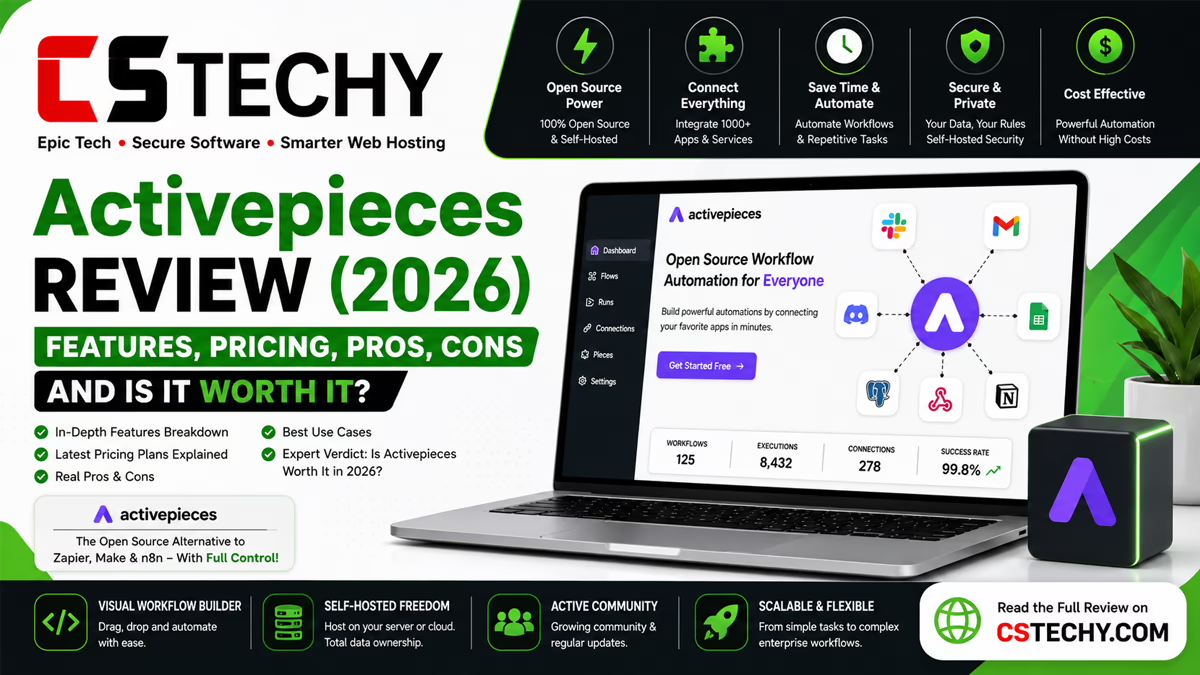
Activepieces Review (2026): Features, Pricing, Pros, Cons and Is It Worth It?
Activepieces has become one of the most talked-about names in open-source automation. If you have searched for a Zapier alternative, an n8n alternative, or a self-hosted way to run AI agents, you have likely come across it.
This Activepieces review looks at everything that matters: features, AI and MCP tools, integrations, pricing, security, and real user feedback. We tested the platform, compared it against competitors, and dug through genuine customer reviews to bring you an honest answer to one question. Is Activepieces actually worth it in 2026?
Activepieces is an open-source, no-code workflow automation platform. It lets you connect apps together visually, without writing code, and it can be run through its managed cloud or self-hosted on your own server.
It suits a wide range of people. Developers and IT teams like the self-hosting option and the MIT-licensed source code. Marketing teams and small businesses like the visual builder and the unlimited-task pricing. AI enthusiasts are drawn to its heavy investment in AI Agents and MCP servers.
Activepieces started life as a smaller open-source project and has grown quickly into a genuine contender against Zapier, Make, and n8n. This review explains exactly why, and where it still falls short.
Quick Take: Activepieces stands out for its open-source core, generous free self-hosted option, and unusually deep native support for AI agents and MCP servers. It is an excellent fit for technical teams and budget-conscious businesses, though non-technical beginners may find a slightly steeper setup than fully hosted competitors.
Quick Verdict
Before we go deep into every feature, here is the short version for readers who want the headline answer first.
| Category | Rating Out of 5 |
|---|---|
| Overall Rating | 4.5 |
| Ease of Use | 4.2 |
| Automation Features | 4.5 |
| AI Features | 4.7 |
| Integrations | 4.2 |
| Templates | 4.0 |
| Pricing | 4.8 |
| Value for Money | 4.7 |
| Support | 3.9 |
Best For
Activepieces is best for developers, IT teams, and small to medium businesses that want an affordable, AI-first automation platform with the option to self-host for full data control.
Pros
- Genuinely free, MIT-licensed, self-hosted Community Edition
- Unlimited task runs on paid cloud plans, priced per active flow instead of per task
- Deep native support for AI Agents and MCP servers
- Open, community-contributed integration library
- Transparent, predictable pricing compared with task-based competitors
Cons
- Self-hosting requires real technical comfort and ongoing maintenance
- Fewer native integrations than larger competitors like Make or Zapier
- Template library is smaller and less polished than more established rivals
- Support can feel slower outside paid enterprise tiers
What is Activepieces?
Activepieces is an open-source, no-code automation platform that lets individuals and businesses connect apps and build automated workflows, called flows, using a visual drag-and-drop builder.
Company History and Background
Activepieces was built from the ground up as an open-source alternative to Zapier, with its core released under the permissive MIT licence. This meant anyone could inspect the code, self-host it for free, and contribute new integrations back to the community.
That open, community-driven approach helped Activepieces grow a loyal following among developers who wanted the convenience of a visual automation builder without being locked into a closed, proprietary platform.
Evolution Into an AI-First Platform
As AI agents and large language models became central to modern automation, Activepieces moved quickly to build AI directly into its core rather than bolting it on as an afterthought. It introduced native AI Agents and became one of the earliest automation platforms to support the Model Context Protocol, or MCP, at scale.
Each integration in Activepieces, called a piece, was designed as a type-safe building block written in TypeScript, and many of these pieces now double as MCP servers that AI agents like Claude can call directly as tools.
Current Market Position
Today, Activepieces positions itself as a serious open-source rival to Zapier, Make, and n8n, with a particular edge in AI agent and MCP support. Its combination of a free self-hosted edition and unlimited-task cloud pricing has made it especially popular with cost-conscious developers, startups, and technical teams.
Expert Tip: If you already run a small server or VPS for other tools, self-hosting the Community Edition is one of the most cost-effective ways to run unlimited automations without ongoing subscription costs.
Key Features
Activepieces combines a clean visual builder with genuinely advanced flow control and AI capability. Here is a detailed look at what matters most.
Visual Flow Builder
The visual flow builder lets you drag pieces onto a canvas and connect them step by step, so you can see the entire automation at a glance rather than reading a plain list of instructions.
Drag-and-Drop Automation
Building a flow feels approachable even for non-technical users. You choose a trigger, add action steps, and configure each one through a simple side panel, without touching any code.
AI Agents
AI Agents are one of Activepieces’ defining features, letting a flow make autonomous decisions and take multiple steps toward a goal, rather than following a single fixed path. We cover this in more depth in the dedicated AI Features section below.
Branches and Conditional Logic
Activepieces supports branching logic, letting a flow follow different paths depending on the data it receives, similar to a router in other platforms. This makes it possible to build genuinely complex, real-world processes rather than simple linear chains.
Loops
The loop feature processes a list of items one at a time within a flow, such as handling every row in a spreadsheet or every item in an order, before continuing to the next step.
Filters
Filters let you stop a specific path in a flow unless a condition is met, ensuring only the right records continue through the rest of the automation.
Scheduling
Flows can run instantly from a trigger, or on a schedule you define, which suits recurring tasks like daily reports or weekly data syncs that do not need real-time execution.
Variables and Data Mapping
Activepieces lets you store and reuse values across a flow, and map data cleanly between steps, so information like a customer’s name or order number flows through the whole automation correctly.
Webhooks
Webhooks allow an external service to trigger an Activepieces flow the moment something happens elsewhere, giving near real-time responsiveness for time-sensitive automations.
Custom Code Steps
For anything a native piece cannot handle, Activepieces allows custom TypeScript code steps directly inside a flow, giving developers an escape hatch without needing to leave the platform.
Tables
Built-in Tables give you a simple, spreadsheet-like database directly inside Activepieces, useful for storing and referencing data without needing a separate external tool.
MCP Servers
Many Activepieces pieces double as MCP servers, meaning external AI tools like Claude Desktop or Cursor can call them directly as tools. This is one of the platform’s standout technical features and is covered in more depth below.
Error Handling
Flows can include dedicated error-handling steps, so a failed action triggers a fallback, like a notification, instead of silently breaking the rest of the automation.
Execution History
Every flow run is logged, showing exactly what data passed through each step, which is essential for debugging and confirming an automation behaved as expected.
Version Control
Activepieces keeps a history of changes to your flows, since being open source also means technical teams can track changes through their own version control workflows when self-hosting.
Cloud and Self-Hosted Execution
Unlike fully hosted competitors, Activepieces gives you a genuine choice. Run flows on its managed cloud for convenience, or self-host the Community Edition on your own infrastructure for complete control.
Community-Contributed Pieces
A significant share of Activepieces’ integrations, often estimated at more than half, come from community contributions, reflecting its open development model.
Team Collaboration
Higher-tier plans support team roles and shared flows, letting multiple people build and manage automations together with defined permissions.
Monitoring and Governance
Enterprise-tier features add role-based access control, audit logs, and single sign-on, giving larger organisations the governance controls needed for compliance-sensitive automation.
AI Features
Activepieces markets itself as an AI-first automation platform, and its AI tooling is genuinely one of its strongest areas.
AI Agents
Activepieces AI Agents can reason through a request, decide on an action, and carry out multiple steps autonomously, maintaining context as they work through a task rather than following one rigid script.
MCP Server Support
Activepieces supports the Model Context Protocol at genuine scale, with hundreds of its integrations doubling as MCP servers. This means AI clients like Claude Desktop or Cursor can call an Activepieces piece directly as a tool, without needing a custom integration built from scratch.
OpenAI Integration
Native OpenAI pieces let you bring GPT-style text generation directly into a flow, for tasks like drafting content or classifying incoming data.
Claude Integration
Activepieces includes native support for Anthropic’s Claude models, both as a usable piece inside flows and as an MCP client that can call Activepieces automations as tools.
Other AI Model Support
Beyond OpenAI and Claude, Activepieces supports a growing list of AI providers, giving teams flexibility to choose the model that best fits their budget and use case.
Prompt Automation
You can build reusable prompt steps inside a flow, ensuring a well-tested prompt runs consistently every time, rather than being rewritten manually for each new use case.
Content Generation
AI pieces can draft emails, summaries, and other content automatically as part of a larger flow, though a human review step remains sensible before anything reaches a customer directly.
Customer Support Automation
AI Agents can read incoming support messages, summarise the core issue, and suggest a response for a human agent to review, reducing time spent on first-response drafting.
Warning: Give AI Agents only the specific data and tools they genuinely need for a task. Broad, unnecessary access increases risk if an agent behaves unexpectedly.
Integrations
Activepieces offers a growing library of integrations, known as pieces, built by both the core team and the open-source community.
Productivity and Collaboration
Google Workspace, Slack, Discord, and Notion are all natively supported, covering many of the core collaboration tools smaller teams already rely on daily.
CRM and Sales
HubSpot integration allows automated lead syncing and follow-up tasks between Activepieces and your CRM, without manual data entry.
E-commerce and Payments
Shopify, WooCommerce, and Stripe integrations support automated order processing and payment notifications for online stores.
Content and Websites
WordPress integration allows automated publishing and form handling directly from an Activepieces flow.
Developer Tools
GitHub integration supports automation around code repositories, such as posting a notification whenever a new issue is created.
AI Providers
OpenAI and Anthropic Claude both have dedicated pieces, alongside growing support for additional AI providers, reflecting the platform’s AI-first positioning.
Spreadsheets and Data
Google Sheets integration remains one of the most popular building blocks, often used as a lightweight database for smaller automations, alongside built-in Tables for a more native option.
Custom API Connections
For any app without a dedicated piece, Activepieces supports custom HTTP requests and code steps, meaning it is rarely limited by a missing native integration.
Templates
Activepieces provides a template library to help new users get started quickly, though it is smaller than some longer-established competitors.
Ready-Made Templates
Templates cover common automation patterns across several departments, letting you clone a working flow and adjust it to your own connected accounts.
AI Agent Templates
A growing set of templates focuses specifically on AI Agent use cases, such as summarising customer feedback or triaging support requests automatically.
Marketing Templates
Marketing-focused templates typically cover lead capture, social scheduling, and simple email follow-up sequences.
CRM Templates
CRM templates handle common tasks like syncing new leads and updating records automatically as deals progress.
E-commerce Templates
These templates automate order confirmations and basic inventory or fulfilment notifications for online stores.
Finance Templates
Finance-related templates cover simple invoicing and payment notification workflows for smaller businesses.
Productivity Templates
Productivity templates cover everyday tasks, like turning a form submission into a task in a project management tool.
Pricing
Activepieces uses a genuinely distinctive pricing model. Instead of charging per task or per operation, its cloud plans charge based on the number of active flows, with unlimited task executions included.
Community Edition (Self-Hosted)
The Community Edition is free and open source under the MIT licence. You can self-host it on your own server with no task limits and no flow limits, though you take on the responsibility of setup, updates, and ongoing maintenance yourself.
Standard Plan (Cloud)
The Standard cloud plan includes ten active flows for free, with unlimited runs, AI agents, and unlimited MCP servers included. This makes it genuinely usable for small businesses and solo users without paying anything.
Paid Active Flows
Beyond the ten free active flows, each additional active flow costs a flat monthly fee. Because pricing is based on active flows rather than task volume, a flow that runs ten thousand times a month costs the same as one that runs only occasionally.
Unlimited Plan (Enterprise)
The Unlimited plan is custom-priced on an annual contract and adds enterprise governance features, including single sign-on, role-based access control, full audit logs, and dedicated support, suited to larger organisations with compliance requirements.
| Plan | Approximate Price | What You Get | Best For |
|---|---|---|---|
| Community Edition | Free, self-hosted | Unlimited flows and runs, full source code | Developers and technical teams |
| Standard (Cloud) | Free | 10 active flows, unlimited runs, AI agents, unlimited MCP servers | Small businesses and solo users |
| Additional Active Flows | Around 5 dollars per flow, per month | Each extra active flow beyond the free 10 | Growing teams scaling usage |
| Unlimited (Enterprise) | Custom annual pricing | SSO, RBAC, audit logs, dedicated support | Larger organisations needing governance |
Understanding Per-Flow Pricing
This model rewards businesses running high-volume automations. A flow that processes thousands of records every month costs exactly the same as a flow that runs once a day, which is a meaningful advantage over task-based or credit-based competitors once volume grows.
Who Should Choose Each Plan
The Community Edition suits developers comfortable managing their own server. The free Standard cloud plan suits solo users and very small businesses with fewer than ten automations. Paying for extra active flows suits growing teams running more automations without wanting to manage infrastructure. The Unlimited plan suits larger organisations that need formal governance and compliance controls.
Beginner Tip: Start on the free Standard cloud plan before considering self-hosting. It lets you learn the platform properly without any server management responsibility.
Ready to try Activepieces for yourself? Start on the free cloud plan or the self-hosted Community Edition, build your first flow, and judge the platform on how much time it saves your business.
Performance
Activepieces performs reliably for most standard use cases, whether run on its managed cloud or self-hosted.
Speed
Simple flows typically execute within seconds of being triggered on the managed cloud. Self-hosted performance depends on the resources of your own server.
Reliability
The managed cloud handles most workloads without issue, while self-hosted reliability depends on how well the underlying infrastructure is maintained and monitored.
Execution Time and Scenario Limits
Individual flow runs have practical execution time limits, so very long-running processes should be broken into smaller, chained flows where possible.
Task Limits and Scalability
Because paid plans charge per active flow rather than per task, Activepieces scales unusually well for high-volume automations, with cost staying flat regardless of how often a flow actually runs.
Security
Activepieces takes a layered approach to security, differing slightly between its self-hosted and managed cloud options.
Encryption
Data moving through Activepieces is encrypted in transit on the managed cloud, and self-hosted deployments inherit whatever encryption standards your own infrastructure applies.
GDPR and HIPAA
The managed cloud states GDPR compliance and claims HIPAA compliance, which matters for businesses handling personal or healthcare-related data within the European Union or United States.
SOC 2 Compliance
Activepieces’ managed cloud holds SOC 2 Type II certification, giving businesses independent verification of its internal security controls for hosted deployments.
Data Hosting Regions
Cloud customers can typically choose between EU or US data hosting regions, which helps businesses meet regional data residency requirements without needing to self-host.
Two-Factor Authentication and SSO
Single sign-on is available on higher-tier plans, alongside role-based access control, giving administrators tighter control over who can view or edit specific flows.
Audit Logs
Full audit logs are available on the Unlimited plan, tracking every change made to every automation, which matters enormously for compliance-sensitive organisations.
Ease of Use
Activepieces balances real technical depth with a genuinely approachable visual interface, though the self-hosting path does raise the bar for less technical users.
Learning Curve
Building a basic flow on the cloud plan is straightforward for most users within an hour, though setting up and maintaining the self-hosted Community Edition requires real server management experience.
Interface
The visual builder is clean and modern, making it easy to follow how data moves between steps in a flow.
Visual Builder
Seeing an entire automation laid out visually makes debugging considerably easier than working through a plain, unstructured list of steps.
Documentation and Tutorials
Activepieces provides solid documentation covering both the cloud product and the self-hosted deployment process, along with growing video content for common use cases.
Community
As an open-source project, Activepieces benefits from an active developer community contributing integrations, fixes, and discussion around real-world use cases.
Real Use Cases
Activepieces fits naturally into a wide range of practical business tasks, particularly where AI Agents or self-hosting add genuine value.
Content Marketing and SEO Automation
Teams use Activepieces to automate content publishing schedules and basic SEO monitoring tasks, flagging changes in ranking data pulled from connected tools.
Lead Generation and Sales
New leads captured from a website form can flow automatically into a CRM, with an AI Agent drafting a personalised first follow-up message for a rep to review.
CRM and Customer Support
Support tickets can be summarised automatically by an AI Agent before reaching a human agent, cutting the time spent reading long, messy customer messages.
Finance and Invoices
Simple invoicing and payment reminder flows can run automatically based on triggers from a connected finance or project tool.
Social Media and AI Content
Flows can generate draft social captions using AI pieces, then schedule them for publishing across connected platforms.
Email Marketing
Behaviour-based email flows can trigger automatically based on data from a CRM or e-commerce platform, personalising each message without manual effort.
Developer and Internal Tooling
Because Activepieces pieces double as MCP servers, developers increasingly use it to give AI coding assistants like Claude Desktop or Cursor safe, structured access to internal tools and data.
Self-Hosted Data-Sensitive Workflows
Organisations handling sensitive data often self-host Activepieces specifically to keep automation infrastructure entirely within their own environment, rather than routing data through a third-party cloud.
Pros and Cons
| Pros | Cons |
|---|---|
| Free, MIT-licensed, self-hosted Community Edition | Self-hosting requires genuine technical maintenance |
| Unlimited task runs on paid cloud plans | Fewer native integrations than larger competitors |
| Deep, genuine AI Agent and MCP server support | Template library is smaller than more established rivals |
| Transparent, predictable per-flow pricing | Support can be slower outside enterprise tiers |
| Open, community-driven integration ecosystem | Newer platform with a shorter track record than Zapier |
Activepieces vs Zapier
Activepieces and Zapier take very different approaches, and the right choice often comes down to budget and technical comfort.
Pricing Comparison
Activepieces is significantly more affordable at scale, since its per-flow pricing includes unlimited task runs, while Zapier’s task-based pricing rises quickly as automation volume grows.
Feature Comparison
Zapier offers a larger, more polished template library and a simpler linear builder, while Activepieces offers deeper AI Agent capability and the option to self-host entirely.
AI Comparison
Activepieces is considerably more AI-native, with deep MCP server support built into its integration architecture from an early stage, while Zapier’s AI features remain more add-on in nature.
Integrations Comparison
Zapier has a larger raw integration count overall, though Activepieces continues to grow quickly through community contributions.
Speed Comparison
Both platforms perform well for standard automation volumes, with Activepieces holding a clear cost advantage for very high-frequency flows specifically.
Ease of Use Comparison
Zapier remains easier for absolute beginners with zero technical background, while Activepieces rewards users willing to invest slightly more time, particularly if self-hosting is on the table.
Expert Tip: If you run high-volume automations on a tight budget, calculate your expected monthly cost on both platforms before committing. Activepieces often wins decisively once volume climbs.
Activepieces vs n8n
Activepieces and n8n are the two leading open-source automation platforms, and both appeal strongly to technical users.
Hosting Comparison
Both platforms offer genuine self-hosting alongside a managed cloud option, giving technical teams full control over where their automation infrastructure lives.
Open Source Comparison
Both are open source, though Activepieces uses the permissive MIT licence for its Community Edition, while n8n uses a more restrictive fair-code licence with certain commercial limitations.
Pricing Comparison
Activepieces prices its cloud plans per active flow with unlimited runs, while n8n’s cloud pricing is typically based on workflow executions, meaning the better value option depends heavily on how often your automations actually run.
Flexibility Comparison
n8n has a longer track record and a larger, more mature integration library, while Activepieces has moved faster and further on native AI Agent and MCP server support.
Developer Comparison
Both platforms suit developers well, with Activepieces’ type-safe TypeScript pieces framework appealing to teams already comfortable in that ecosystem.
AI Comparison
Activepieces currently has the edge on MCP server coverage specifically, with a large share of its integrations doubling as callable AI tools, which n8n is still catching up on at the same scale.
Customer Reviews
We reviewed genuine feedback from trusted review platforms to understand how real users feel about Activepieces.
Positive Feedback
Users consistently praise the unlimited-task pricing model, noting real savings compared with task-based competitors once automation volume grows.
Reviewers also highlight the AI Agent and MCP features specifically, often describing Activepieces as ahead of larger competitors on genuine AI-native capability.
Negative Feedback
Some users note that the integration library, while growing quickly, still falls short of more established platforms for certain niche or regional apps.
Common Complaints
The most common complaint relates to support response times outside paid enterprise tiers, along with the genuine technical effort required to self-host and maintain the Community Edition properly.
Is Activepieces Worth It?
Yes, for most technical teams and budget-conscious businesses, Activepieces is genuinely worth it. It offers a rare combination of a free, open-source core and genuinely advanced AI capability.
Who Should Buy Activepieces
- Developers and IT teams wanting a self-hosted, open-source automation platform
- Small to medium businesses running high-volume automations on a budget
- Teams building AI Agent workflows that need genuine MCP server support
- Organisations wanting full control over where automation data is processed
Who Should Avoid Activepieces
- Absolute beginners wanting the simplest possible, fully hosted experience
- Businesses needing the very largest integration library available today
- Teams unwilling to invest any time in self-hosting or platform learning
Try Activepieces Today: With a genuinely free cloud plan and a fully free self-hosted option, there is little reason not to test Activepieces against your own real workflows before committing to anything.
Frequently Asked Questions
What is Activepieces used for?
Activepieces is used to connect apps and automate repetitive tasks, both through its managed cloud and its free, self-hosted Community Edition. Businesses use it for lead capture, CRM syncing, support ticket summarisation, and AI Agent-powered workflows. Developers particularly value it for building AI Agents that use MCP servers to safely call other tools and services. The platform works through a visual flow builder, where you drag pieces onto a canvas and connect them using triggers, actions, branches, and loops. This makes it flexible enough for simple automations and genuinely complex, AI-driven workflows involving multiple decision points. Because Activepieces is open source, technical teams also use it as a foundation to build and embed their own custom automation features into other products.
Is Activepieces free to use?
Yes, in two genuine ways. The Community Edition is free and open source under the MIT licence, and can be self-hosted on your own server with no task or flow limits, though you take on setup and maintenance yourself. The managed cloud also offers a free Standard plan, including ten active flows with unlimited runs, AI Agents, and unlimited MCP servers included. This makes Activepieces one of the more generous free offerings in the automation space, whether you prefer a hosted experience or full control over your own infrastructure. Most solo users and very small businesses can comfortably run their automation needs entirely within the free cloud tier, only needing to pay once they genuinely require more than ten active flows running at the same time.
How does Activepieces pricing work?
Activepieces prices its cloud plans based on the number of active flows rather than the number of tasks or operations performed. The Standard plan includes ten active flows for free, with unlimited runs included at no extra cost. Beyond that, each additional active flow costs a flat monthly fee, regardless of how often it actually runs. This differs significantly from task-based or credit-based competitors, where cost rises directly with usage volume. A flow that runs ten thousand times a month costs exactly the same as one that runs only occasionally, which makes Activepieces particularly cost-effective for high-volume, frequently triggered automations once you move beyond the free tier. Businesses expecting rapid growth in automation volume should factor this pricing shape into their long-term planning from the very start.
Is Activepieces better than Zapier?
Activepieces and Zapier serve different priorities, so the better choice depends on your needs. Activepieces is significantly more affordable at scale, thanks to unlimited task runs on its per-flow pricing, and it offers considerably deeper AI Agent and MCP server capability. Zapier remains easier for absolute beginners, with a larger, more polished template library and a simpler linear builder. If you expect high automation volume or want genuine AI Agent functionality, Activepieces likely offers better long-term value. If you want the simplest possible experience with zero technical setup and do not mind task-based pricing, Zapier may still feel more approachable for very simple, low-volume needs. Testing both on a real workflow is the fastest way to settle the question for your specific business.
Is Activepieces better than n8n?
Activepieces and n8n are closely matched, since both are open-source platforms supporting self-hosting and a managed cloud option. Activepieces currently holds an edge in native AI Agent and MCP server support, with a large share of its integrations doubling as callable AI tools. n8n has a longer track record and a larger, more mature integration library overall. Licensing also differs, with Activepieces using the more permissive MIT licence for its Community Edition, compared with n8n’s fair-code licence. Teams prioritising AI Agent workflows and MCP coverage often lean toward Activepieces, while teams wanting the broadest, most established integration ecosystem may still prefer n8n. Both are strong choices, and the right pick often comes down to which specific integrations and licensing terms matter most for your project.
Can beginners use Activepieces?
Yes, particularly on the managed cloud plan, where building a basic flow is genuinely approachable within an hour, even without prior automation experience. The visual builder makes it easy to see how data moves between steps. However, self-hosting the Community Edition is a different story, and does require real technical comfort with servers, deployment, and ongoing maintenance. Beginners are strongly advised to start on the free cloud plan first, build confidence with the visual builder and AI Agent features, and only consider self-hosting later if data control or cost at scale becomes a genuine priority for the business. Working through a template rather than a blank canvas is usually the fastest way for a newcomer to understand how the pieces fit together.
Does Activepieces support AI automation?
Yes, extensively. Activepieces was built as an AI-first platform, offering native AI Agents that can reason through a request and take multiple autonomous steps toward a goal. It also supports the Model Context Protocol at genuine scale, with hundreds of its integrations doubling as MCP servers that external AI tools like Claude Desktop or Cursor can call directly. Native pieces for OpenAI and Anthropic Claude let you bring text generation and reasoning directly into a flow. This combination of AI Agents and deep MCP support is one of the strongest arguments for choosing Activepieces over more traditional, rule-only automation platforms, especially for teams already experimenting with AI tools elsewhere in their business.
Is Activepieces safe and secure?
Yes, with security depending on whether you use the managed cloud or self-hosted Community Edition. The managed cloud holds SOC 2 Type II certification, states GDPR compliance, and claims HIPAA compliance, with a choice of EU or US data hosting regions. Self-hosted deployments inherit whatever security standards your own infrastructure applies, giving technical teams full control but also full responsibility for encryption, access control, and patching. Higher-tier cloud plans add single sign-on, role-based access control, and full audit logs, which matter significantly for larger organisations with formal compliance requirements around their automation infrastructure. Businesses in regulated industries should confirm these credentials directly against their own compliance checklist before relying on them fully.
Can I self-host Activepieces?
Yes, and this is one of Activepieces’ strongest differentiators. The Community Edition is free and open source under the MIT licence, and can be deployed on your own server with no task limits and no flow limits. This gives businesses complete control over where their automation data is processed, which matters enormously for organisations with strict data residency or compliance requirements. Self-hosting does require genuine technical comfort, including handling updates, security patches, and uptime monitoring yourself, so businesses without dedicated technical resources may prefer the managed cloud option instead, despite the additional cost involved. Many teams start with the cloud plan and migrate to self-hosting only once their technical capacity and data requirements genuinely justify it.
Does Activepieces offer templates?
Yes, Activepieces provides a template library covering common automation patterns across marketing, sales, CRM, e-commerce, and finance, alongside a growing set of AI Agent-specific templates. Templates let you clone a working flow and adjust it to your own connected accounts, rather than starting from a completely blank canvas. The library is smaller than some more established competitors, reflecting the platform’s relative youth, but it continues to grow steadily alongside the wider integration ecosystem. New users are encouraged to start from a relevant template where one exists, since it is usually faster than mapping every field manually from scratch, and it also demonstrates good practice for structuring branches, loops, and error handling correctly.
Is Activepieces good for developers?
Yes, Activepieces is particularly well suited to developers, thanks to its open-source MIT-licensed core, type-safe TypeScript pieces framework, and genuine self-hosting option. Developers can inspect the underlying code, build custom pieces, and contribute integrations back to the community. The platform’s deep MCP server support also appeals strongly to developers building AI Agent workflows, since existing Activepieces pieces can be exposed directly as tools for AI clients like Claude Desktop or Cursor. Custom code steps further extend what a flow can do, giving developers an escape hatch whenever a native piece does not cover a specific requirement, without needing to abandon the visual builder entirely for that step.
What is the difference between Activepieces Community Edition and the cloud plan?
The Community Edition is the free, open-source, self-hosted version of Activepieces, released under the MIT licence with no task or flow limits, but requiring you to manage your own server and infrastructure. The cloud plan is Activepieces’ managed hosting option, removing the need for server management entirely, with a free Standard tier covering ten active flows and unlimited runs. Paid cloud tiers add more active flows, team collaboration features, and eventually enterprise governance controls like SSO and audit logs. Choosing between them typically comes down to whether your team has the technical resources to self-host, and whether data residency requirements make self-hosting a genuine necessity rather than a preference worth paying to avoid.
How many integrations does Activepieces support?
Activepieces supports several hundred integrations, known as pieces, covering categories including productivity tools, CRM platforms, e-commerce and payment providers, developer tools, and major AI providers. A significant share of these pieces come from community contributions, reflecting the platform’s open development model. For any app without a dedicated native piece, Activepieces supports custom HTTP requests and code steps, meaning the platform is rarely completely blocked by a missing integration, even though this requires more technical comfort than using a ready-made piece. The integration library continues to grow steadily as the open-source community contributes new pieces, so it is always worth checking the current directory before assuming an app is unsupported.
Is Activepieces suitable for enterprise use?
Yes, Activepieces offers a dedicated Unlimited plan built for larger organisations with more demanding governance and compliance requirements. This typically includes single sign-on, role-based access control, full audit logs, and dedicated support, priced on a custom annual contract. Combined with SOC 2 Type II certification and stated GDPR and HIPAA compliance on the managed cloud, Activepieces provides a credible option for enterprise teams that also want the flexibility of open-source software underneath. Larger organisations should still involve their own security and legal teams early, to confirm Activepieces’ compliance credentials satisfy any industry-specific regulations relevant to their data, particularly in healthcare, finance, or other heavily regulated sectors.
Is Activepieces worth it in 2026?
Yes, for most developers, technical teams, and budget-conscious businesses, Activepieces is genuinely worth it in 2026. Its combination of a free, open-source self-hosted core, unlimited-task cloud pricing, and genuinely advanced AI Agent and MCP server support sets it apart from many competitors. It is less ideal for absolute beginners wanting the simplest possible fully hosted experience with the largest available template library. For teams running high-volume automations, building AI Agent workflows, or wanting full control over where their data is processed, Activepieces is one of the strongest options currently available, and its free tiers make it very low risk to test properly before committing any real budget to a paid plan.
Final Verdict
Activepieces has earned its place as one of the most credible open-source automation platforms available in 2026. It combines a genuinely usable visual builder with real technical depth, and it leads much of the market on native AI Agent and MCP server support.
Its pricing model is one of its biggest strengths. Charging per active flow rather than per task means high-volume automations do not quietly become expensive, and the free self-hosted Community Edition remains one of the most generous options anywhere in the automation space.
The trade-offs are real too. Self-hosting demands genuine technical resources, the integration library is smaller than more established rivals, and support outside enterprise tiers can be slower than some businesses would like.
If you are searching for a genuinely capable Zapier alternative or n8n alternative, particularly one built around AI Agents from the ground up, Activepieces deserves a serious look. Start with the free cloud plan or the self-hosted Community Edition, build a real flow using your own tools, and judge the platform on results rather than marketing claims alone.
Start your free Activepieces trial today and see exactly how much an AI-first, open-source automation platform can do for your business.
Frequently Asked Questions
1. Is Activepieces free to use?
Yes. Activepieces offers a free plan with generous automation capabilities. Businesses needing advanced features, higher execution limits, team collaboration, and enterprise support can upgrade to paid plans.
2. Is Activepieces open source?
Yes. Activepieces is an open-source workflow automation platform. You can inspect the source code, contribute to development, or self-host it on your own server for complete control.
3. Can I self-host Activepieces?
Absolutely. Activepieces supports self-hosting using Docker, making it an excellent choice for organisations that require data privacy, security, and full infrastructure control.
4. Is Activepieces better than Zapier?
Activepieces is generally more affordable and supports self-hosting, while Zapier offers a larger integration ecosystem and a more mature automation platform. The better choice depends on your workflow requirements and budget.
5. How many integrations does Activepieces support?
Activepieces supports hundreds of integrations, including Gmail, Slack, Google Sheets, OpenAI, Discord, Notion, Airtable, HubSpot, Shopify, and many more, with new connectors added regularly.
6. Does Activepieces support AI automation?
Yes. Activepieces includes AI features that work with popular models like OpenAI and other AI providers, allowing users to automate content generation, customer support, document processing, and intelligent workflows.
7. Is Activepieces suitable for small businesses?
Yes. Its affordable pricing, simple workflow builder, AI capabilities, and self-hosting options make Activepieces an excellent automation platform for startups, freelancers, and growing businesses.
8. Is Activepieces secure?
Activepieces provides secure cloud hosting and also allows self-hosting, enabling organisations to maintain complete control over sensitive data, compliance, and internal security policies.
9. Is Activepieces worth using in 2026?
Yes. If you want a powerful, affordable, AI-powered workflow automation platform with open-source flexibility and self-hosting support, Activepieces is one of the best alternatives to Zapier and Make in 2026.