ActiveCampaign is one of the more established names in marketing automation, positioning itself as an “autonomous marketing platform” that combines email marketing, a built-in CRM, and AI-assisted automation in one product. Businesses consider it when they’ve outgrown a basic email tool and need automation that reacts to customer behavior rather than just sending scheduled newsletters.
This review is written for readers evaluating ActiveCampaign in 2026 — whether you’re comparing it against HubSpot or Mailchimp, trying to understand what its AI features actually do, or simply working out whether the pricing makes sense for your contact list. It covers what ActiveCampaign is, how it works, its current AI capabilities, pricing and plan differences, genuine strengths and limitations, and how it stacks up against alternatives.
Affiliate Disclosure: This article may contain affiliate links. If you sign up through them, CSTechy may earn a commission at no additional cost to you. Our review and conclusions are independent of any affiliate relationship. This review is based on ActiveCampaign’s published documentation and independent research rather than first-hand CSTechy testing.
What Is ActiveCampaign?
ActiveCampaign is a marketing automation and customer experience platform built around four core pillars: email marketing, marketing automation, a sales CRM, and — increasingly — AI tools that assist with building and optimizing campaigns. At its foundation, it lets businesses collect contacts, segment them based on behavior and attributes, and design automated “customer journeys” that send the right message at the right time.
Unlike a simple newsletter tool, ActiveCampaign’s automation engine can branch based on conditions (has this contact opened an email, visited a page, or made a purchase?), update CRM records, assign sales tasks, and coordinate messages across email, SMS, and other channels. That combination of marketing automation and sales CRM in one product is what differentiates it from lighter tools like Mailchimp and what puts it in indirect competition with heavier suites like HubSpot.
How Does ActiveCampaign Work?
ActiveCampaign’s automation model follows a consistent logical structure, regardless of which specific automation you’re building:
- Contact — a person enters your database, typically through a form, integration, or import.
- Trigger — an event starts an automation: a form submission, a tag being added, an email being opened, a purchase, or a date-based event.
- Automation — the visual workflow builder maps out what happens next.
- Conditions — if/else branches route contacts down different paths based on their data or behavior.
- Actions — the automation sends an email, waits, updates a CRM deal, adds a tag, notifies a team member, or triggers an integration.
- Segmentation — contacts are grouped by tags, custom fields, or behavior so future messaging stays relevant.
- Communication — email, SMS, or on-site messaging goes out based on the workflow logic.
- Reporting — campaign and automation performance is tracked so you can see what’s working.
A simple beginner example: a visitor downloads a lead magnet (trigger) → they’re tagged “lead-magnet-download” → the automation checks whether they’re already a customer (condition) → if not, they enter a five-email nurture sequence (action) spaced over two weeks → if they click a pricing link, a task is created for a salesperson to follow up (CRM action). That’s the basic shape of most ActiveCampaign automations, just with more branches as complexity grows.
What Can ActiveCampaign Do?
Based on ActiveCampaign’s current documentation and product pages, the platform supports a broad set of use cases:
- Email campaigns and newsletters with a drag-and-drop builder
- Behavior-based lead nurturing sequences
- Multi-step customer journeys across email and other channels
- Sales automation, including deal-stage updates and task assignment
- CRM pipeline management for sales teams
- Advanced segmentation based on tags, custom fields, and behavior
- Personalized messaging and conditional content
- Ecommerce marketing, including integrations with Shopify, WooCommerce, BigCommerce, and Magento
- Forms and landing pages for lead capture (plan-dependent)
- Campaign and automation reporting
- Integrations with hundreds of third-party tools
Availability of some of these — particularly landing pages, conditional content, and certain reporting features — depends on which plan you’re on, which is covered in the pricing section below.
ActiveCampaign Key Features
Based on ActiveCampaign’s current published information, here’s what the platform offers at a feature level:
- Email marketing: A visual email builder with a large template library, available across all plans.
- Marketing automation: A workflow builder supporting branching logic, goal tracking, and hundreds of pre-built automation recipes. Which specific triggers and actions are available can depend on your plan, so plan-specific automation claims should always be checked against current documentation rather than assumed.
- CRM and sales automation: Deal pipelines, contact and company records, and sales task automation — available from the Plus plan upward.
- Segmentation: Tag-based and behavior-based segmentation, with AI-suggested segments on higher tiers.
- Landing pages and forms: A landing page builder is available starting on the Plus plan; forms are available more broadly.
- Integrations: Several hundred native and Zapier-based integrations spanning ecommerce, CRM, webinar, and productivity tools.
- Reporting: Campaign-level reporting is available on all plans, with deeper attribution and automation reporting on Professional and Enterprise.
- Predictive capabilities: Predictive sending (optimizing send time per contact) is documented as a Professional-and-above capability.
- Multi-channel messaging: Email plus SMS two-way messaging, with channel availability varying by plan and region.
ActiveCampaign AI: What Active Intelligence Actually Does
ActiveCampaign markets itself heavily around AI, so it’s worth separating what’s documented and currently available from general marketing language.
ActiveCampaign’s current help center describes Active Intelligence as a beta feature Beta — an autonomous, context-aware assistant built into the platform that can help you create campaigns, build automations, and analyze performance through a conversational interface. According to ActiveCampaign’s documentation, Active Intelligence can generate a full email campaign from a plain-language description, build a visual automation from a written instruction (mapping your request to standard actions like sending an email, waiting, branching on conditions, or updating a CRM deal), and answer questions about how past campaigns or automations performed.
A newer capability, Autonomous Insights, was introduced in early 2026. According to ActiveCampaign’s help center, this feature proactively surfaces weekly, unprompted insights and optimization suggestions on your homepage, rather than requiring you to ask a question first. ActiveCampaign also announced at its Spring 2026 keynote that it is expanding toward “agent-to-user” AI — where the system initiates recommendations based on performance signals — and AI personalization that lets businesses tune Active Intelligence to their brand voice.
Separately, ActiveCampaign’s AI Actions Library is documented as supporting discrete tasks such as content generation, sentiment analysis, classification, personalization, and translation that can be inserted into automations as individual steps, distinct from the conversational Active Intelligence assistant.
A few things worth understanding before you rely on any of this:
- Beta status: Active Intelligence is officially labeled a beta feature by ActiveCampaign, meaning functionality can change.
- Plan dependency: According to ActiveCampaign’s AI overview documentation, access to specific AI capabilities depends on your plan — generative features like campaign building are broadly available, while predictive and analytical AI features are documented as requiring Professional or higher.
- Data use: ActiveCampaign’s help center states that it does not currently use customer contact or marketing content data to train its AI models, though readers evaluating this for compliance-sensitive use cases should verify the current data-use terms directly.
None of this means ActiveCampaign “completely automates marketing” — the AI drafts, suggests, and can act within defined workflows, but campaigns and automations still go through a visual builder where every step is editable before it runs.
ActiveCampaign Pricing 2026
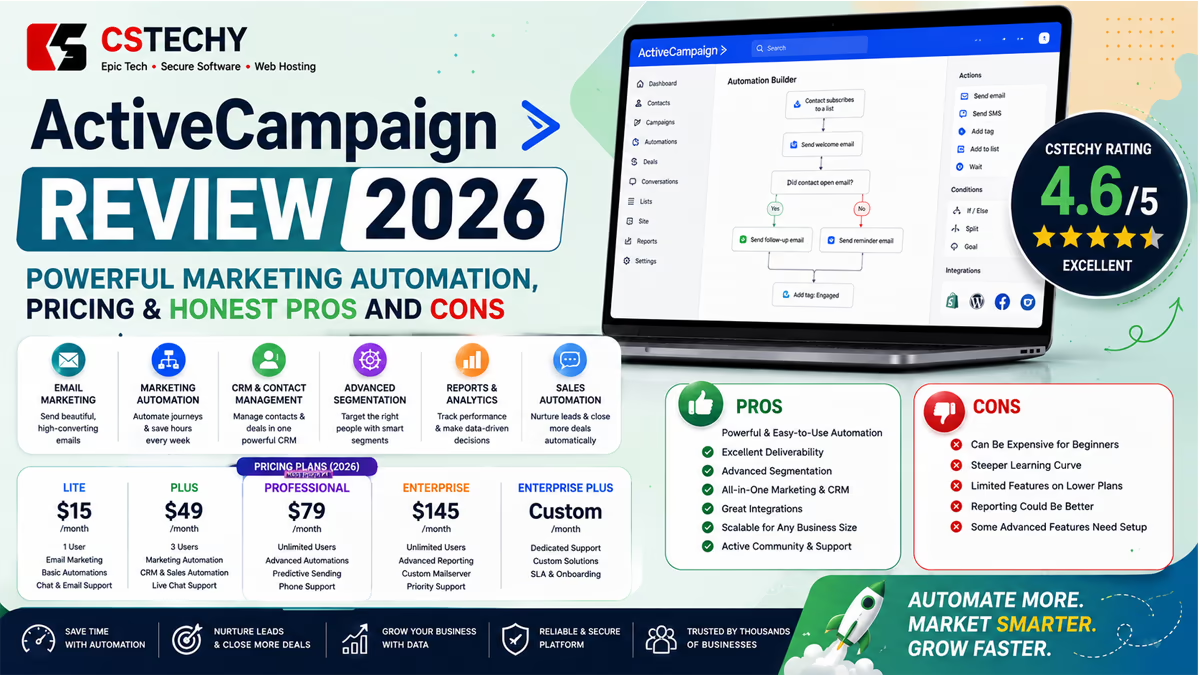
Pricing checked: August 2026 — ActiveCampaign sells four paid plans, and — importantly — pricing scales with your number of contacts, not just the plan tier. The figures below reflect the entry tier (1,000 contacts, billed annually), corroborated across ActiveCampaign’s own pricing page and independent coverage as of this check. Prices change, so confirm the live numbers on ActiveCampaign’s official pricing page before you buy.
| Plan | Best For | Key Features | Important Limits |
|---|---|---|---|
| Starter — from $15/mo | Small businesses and solo marketers starting out | Email marketing, basic marketing automation, forms, site tracking, generative AI campaign building | No CRM or landing pages; more limited automation triggers/actions than higher tiers; not offered above roughly 25,000 contacts |
| Plus — from $49/mo | Growing businesses that need CRM and deeper automation | CRM and deal pipelines, landing page builder, lead scoring, AI-suggested segments, sentiment analysis | Predictive sending and conditional content still gated to Professional |
| Professional (Pro) — from $79/mo | Marketing/sales teams wanting predictive and attribution tools | Predictive sending, conditional content, split testing, conversion attribution, priority support, ecommerce integrations with BigCommerce/Magento/Shopify Plus | Advanced CRM integrations (Salesforce, Microsoft Dynamics) and SSO reserved for Enterprise |
| Enterprise — from $145/mo | Larger organizations needing governance and dedicated support | SSO, custom objects, premium CRM integrations, custom reporting, dedicated account team | Premium pricing; still scales upward with contact count |
Two things consistently trip up buyers comparing ActiveCampaign to competitors:
- Contact-based scaling: The advertised prices above are for 1,000 contacts. Costs rise at defined contact bands (roughly 2,500, 5,000, 10,000, and beyond), so a growing list can push your bill up independent of which plan you choose.
- Add-ons: Features like SMS, enhanced CRM/sales engagement tools, custom reporting, additional AI Actions usage, and transactional email (via ActiveCampaign Postmark) sit outside the base plan price and are billed separately.
Is ActiveCampaign Free?
No — ActiveCampaign does not offer a permanently free plan. It offers a 14-day free trial across its plans. According to current third-party and vendor-adjacent sources, the trial gives access to Professional-tier features so you can evaluate the platform’s full capability before committing, though trial contact and send limits apply. Because trial terms are the kind of detail that changes without much notice, confirm the current trial length, feature access, and any contact/send caps directly on ActiveCampaign’s signup page before relying on it for evaluation.
Is ActiveCampaign Good for Beginners?
This is genuinely mixed, and a balanced answer requires looking at both sides.
Beginner-friendly aspects
- A visual, drag-and-drop automation builder rather than code
- A large library of pre-built automation and email templates
- Guided onboarding and in-app tutorials for core features
- Conversational AI campaign/automation creation that can produce a working draft from a plain-language description
- Broad native integrations that reduce manual setup work
Potential difficulties
- Advanced automation logic (multiple branching conditions, goal tracking) has a real learning curve
- CRM configuration and deal-pipeline setup require more marketing-operations knowledge than a simple email tool
- Pricing complexity — figuring out your real monthly cost across contacts, plan tier, and add-ons takes some work
- Some features that competitors bundle at entry level (landing pages, conditional content) sit behind higher tiers here
In short: sending your first email campaign is straightforward, but getting real value out of ActiveCampaign’s advanced automation and CRM tools takes more time than a purely beginner-focused tool like Mailchimp.
ActiveCampaign Advantages
- Deep automation logic: Branching conditions, goal tracking, and multi-channel sequencing go well beyond basic autoresponders.
- Built-in CRM: Marketing and sales data live in one system from the Plus plan up, which reduces the need for a separate CRM for smaller sales teams.
- AI that builds real workflows: Active Intelligence’s conversational automation and campaign creation is a genuine differentiator versus tools where “AI” just means subject-line suggestions.
- Extensive template and integration libraries: A large number of pre-built automation recipes and third-party integrations reduce setup time.
- Granular segmentation: Tag- and behavior-based segmentation supports precise targeting as your list grows.
ActiveCampaign Limitations
- Pricing complexity: Contact-based scaling plus plan-gated features plus optional add-ons make it genuinely hard to predict your real monthly cost without running the numbers for your specific list.
- Learning curve: The depth that makes ActiveCampaign powerful also makes it slower to fully learn than simpler tools.
- Feature gating: Capabilities like landing pages, conditional content, and predictive sending sit behind Plus or Professional, which can force an upgrade sooner than expected.
- AI still maturing: Active Intelligence remains in beta, so functionality and reliability may still be evolving.
- Possibly more than simple use cases need: A business that only sends occasional newsletters may find the automation depth unnecessary relative to a lighter, cheaper tool.
ActiveCampaign vs Competitors
ActiveCampaign vs HubSpot
These platforms serve different buyers more than they compete head-to-head. ActiveCampaign is an automation-and-CRM specialist; HubSpot is a broader all-in-one suite spanning marketing, sales, and service “hubs.” Independent comparisons generally note that ActiveCampaign’s paid plans include real marketing automation at every tier, while HubSpot’s entry-level Marketing Hub plan has limited automation, with full workflow automation typically requiring HubSpot’s more expensive Professional or Enterprise tiers. HubSpot’s advantage tends to show up in CRM depth for larger sales teams, native reporting breadth, and having marketing, sales, and service data unified in one platform. For a small-to-mid-size team prioritizing automation depth per dollar, ActiveCampaign is generally positioned as the better value; for a larger organization wanting one system across multiple departments, HubSpot’s broader suite may justify its higher price. Neither is a universal winner — it depends on whether you need an automation specialist or an all-in-one platform.
ActiveCampaign vs Mailchimp
This comparison is more about complexity versus simplicity. Mailchimp is generally regarded as easier to learn and faster to set up, with a broader out-of-the-box marketing feature set (including a free tier for very small lists) but shallower automation — its workflows are typically described as topping out at basic if/else logic. ActiveCampaign’s automation builder supports deeper branching, multi-channel sequencing, and a built-in CRM that Mailchimp doesn’t natively offer. If your priority is simplicity and speed for straightforward campaigns, Mailchimp is generally the easier starting point; if you need automation that reacts to detailed customer behavior and want CRM and marketing in one place, ActiveCampaign is the stronger fit — at the cost of a steeper learning curve.
ActiveCampaign vs Klaviyo
For ecommerce-specific marketing, Klaviyo is a frequently cited alternative, built specifically around ecommerce data (order history, product browsing, revenue attribution) integrated tightly with platforms like Shopify. ActiveCampaign also supports ecommerce integrations and revenue reporting, but its automation and CRM tools are built for a broader range of businesses, not ecommerce exclusively. A store that lives and dies by ecommerce-specific segmentation and revenue attribution may find Klaviyo’s ecommerce focus more purpose-built; a business that needs marketing automation plus a general-purpose CRM alongside ecommerce may find ActiveCampaign’s broader toolset more useful.
Who Should Use ActiveCampaign?
- Growing businesses that have outgrown a basic email tool
- Marketing teams that need behavior-based automation, not just scheduled sends
- Small sales teams that want CRM and marketing data in one platform
- Agencies managing automation for multiple clients
- Ecommerce businesses needing automated post-purchase and cart-recovery flows
- Businesses that specifically want AI-assisted campaign and automation building
Who May Not Need ActiveCampaign?
If your needs are limited to basic newsletters, simple one-off email sequences, or lightweight contact management, a simpler and often cheaper platform may serve you just as well without the learning curve or pricing complexity that comes with ActiveCampaign’s deeper automation and CRM tools. That’s not a knock on ActiveCampaign — it’s a reflection of the fact that more powerful tools generally involve more to learn and configure.
ActiveCampaign Alternatives
Depending on what you specifically need, worth comparing against:
- HubSpot — for an all-in-one marketing, sales, and service platform
- Mailchimp — for simpler, faster campaign setup and a free entry tier
- Klaviyo — for ecommerce-specific automation and revenue attribution
- Brevo — for budget-conscious teams wanting email, SMS, and basic CRM together
- GetResponse — for a lower-cost alternative with webinar and funnel features built in
Final Verdict: Is ActiveCampaign Worth It?
ActiveCampaign is a strong choice if automation depth and having CRM and marketing in one platform genuinely matter to your workflow — its automation builder and Active Intelligence AI tools go further than most email-marketing-first competitors, and its entry pricing is competitive against heavier suites like HubSpot. It’s a weaker fit if your needs are simple: occasional newsletters or basic sequences don’t require this much configuration, and the contact-based pricing plus feature gating can add cost and complexity you don’t need.
Biggest advantage: automation depth combined with a genuinely capable AI assistant that can build working campaigns and workflows from plain language, not just suggest subject lines.
Biggest limitation: pricing that’s hard to predict up front, since it depends on contact count, plan tier, and which add-ons you end up needing.
Whether it’s worth it depends on whether your business will actually use the automation and CRM depth it offers — for businesses that will, it’s a well-regarded option in its category; for businesses that won’t, a simpler tool is likely to be both cheaper and easier to run day to day.
Frequently Asked Questions
What is ActiveCampaign?
ActiveCampaign is a marketing automation platform that combines email marketing, behavior-based automation, a sales CRM, and AI-assisted campaign and workflow building in one product.
Is ActiveCampaign worth it?
It depends on your needs. It’s generally considered worth it for businesses that need deep, behavior-based automation and a combined marketing/CRM system. Businesses with simple email needs may find it more than they require.
How much does ActiveCampaign cost?
Paid plans start around $15/month for the Starter plan at 1,000 contacts (billed annually), scaling up through Plus, Professional, and Enterprise to $145/month and beyond, with price increasing as your contact count grows. Confirm current rates on ActiveCampaign’s pricing page before purchasing.
Is ActiveCampaign free?
No. There’s no permanent free plan, but ActiveCampaign offers a 14-day free trial with access reported at Professional-tier feature level; verify current trial terms before signing up.
Is ActiveCampaign good for beginners?
Basic email campaigns are approachable for beginners, but getting full value from ActiveCampaign’s advanced automation branching and CRM setup involves a real learning curve compared to simpler tools.
What is ActiveCampaign used for?
It’s used for email marketing, behavior-triggered automation, customer journey mapping, sales pipeline management, segmentation, and — via its AI Actions Library — tasks like content generation and sentiment analysis within workflows.
Does ActiveCampaign have AI?
Yes. Its Active Intelligence suite (currently in beta) supports conversational campaign and automation creation, proactive performance insights, and an AI Actions Library for tasks like content generation, sentiment analysis, and personalization.
What is Active Intelligence?
Active Intelligence is ActiveCampaign’s built-in, context-aware AI assistant that can build campaigns and automations from plain-language instructions and surface performance insights, with some capabilities gated by plan.
Is ActiveCampaign better than Mailchimp?
Neither is universally “better.” ActiveCampaign offers deeper automation and a built-in CRM; Mailchimp is generally simpler to learn and offers a free entry tier. The right choice depends on how much automation complexity you actually need.
Is ActiveCampaign better than HubSpot?
ActiveCampaign is generally seen as the stronger value for automation-focused small-to-mid-size teams; HubSpot suits larger organizations wanting one unified platform across marketing, sales, and service, typically at a higher price.