Perplexity Review 2026: AI Search, Research, Features, Pricing & Is It Worth It?
Perplexity set out to answer a simple question differently than Google does — instead of returning a page of blue links to sort through, it reads across the web and gives you a synthesized, cited answer directly. In 2026, that original idea has grown into a much broader product: an AI-native browser called Comet, an autonomous research mode, file and app creation tools, and access to multiple frontier AI models in one place.
That raises a genuine question for anyone comparing AI tools right now: is Perplexity worth using instead of, or alongside, a general-purpose assistant like ChatGPT, Claude, or Gemini? The honest answer depends on what you actually want from it. If your primary need is finding and verifying current information quickly, Perplexity’s search-first design gives it a real edge. If you need heavy long-form writing, deep coding assistance, or an assistant tightly wired into a specific software ecosystem, other tools may fit better.
This CSTechy review covers what Perplexity actually does today, how its research and browsing tools work, what its plans include, and how it stacks up against ChatGPT, Gemini, and Claude — so you can decide whether it earns a place in your toolkit.
What Is Perplexity?
Perplexity is often described as an “answer engine” — a search tool built around AI synthesis rather than a list of links. Where traditional search hands you ten results to read through yourself, Perplexity reads across multiple sources, synthesizes a direct answer, and shows the citations behind it so you can verify where the information came from.
That’s a meaningfully different starting point than a general chatbot. A conversational AI assistant draws primarily on what it learned during training, optionally supplemented by search; Perplexity is built around live web retrieval as the default behavior, with conversational follow-up layered on top. This makes it particularly well suited to questions where currency and sourcing matter — recent events, evolving topics, or anything you specifically want to trace back to a primary source.
That said, having a citation attached to an answer is not the same as the answer being correct. Perplexity can still misread a source, synthesize information in a misleading way, or rely on a source that’s itself unreliable. Treat citations as a way to verify, not as automatic proof of accuracy — for anything important, it’s worth actually opening the source and checking it yourself.
Perplexity Review 2026: What’s New?
2026 has been a significant year of expansion for Perplexity beyond its original search product. Comet, Perplexity’s AI-native browser, dropped its paywall in March 2026 and is now free across Windows, macOS, iOS, and Android — a major shift from its original launch as a $200/month Max-exclusive product in mid-2025. Comet combines ordinary browsing with an in-browser AI assistant that can read the page you’re on, summarize content, and — on paid plans — take autonomous actions across tabs.
Perplexity has also introduced Model Council, a feature on its higher tiers that runs a single query across multiple frontier models simultaneously and shows where they agree or diverge — useful for stress-testing an important conclusion. Alongside this, Perplexity began rolling out Brain, a shared memory system in testing that gives Perplexity Computer and related products richer context across a user’s projects and past sessions. And its plan structure has grown more granular, now spanning Free, Pro, Max, a discounted Education Pro tier, and two Enterprise levels.
Because Perplexity has changed its pricing, feature set, and product lineup multiple times within 2026 alone, treat details here as a snapshot and confirm current specifics on Perplexity’s official pricing and help pages before making a decision based on them.
How Perplexity Works
At a basic level, you ask Perplexity a question the way you might type it into a search bar or ask a chatbot. Behind the scenes, Perplexity searches relevant web sources, reads and synthesizes what it finds, and returns a direct answer with citations linked to the specific sources used. You can then ask follow-up questions, and Perplexity retains the conversational context — refining or expanding on the original answer rather than starting from scratch.
This workflow sits between two familiar experiences: it’s faster and more synthesized than manually opening and reading several search results, but more source-grounded and verifiable than a chatbot answering purely from training data. For questions where you’d normally open several tabs to cross-reference information, this can save real time. For questions that are more about reasoning, creativity, or working through an idea than looking something up, a general-purpose assistant may still be a better fit.
Perplexity’s Core Features
AI-Powered Search
The core experience is asking a question and getting a synthesized, cited answer rather than a list of links. This is genuinely useful when you want a fast, sourced answer to something specific — a factual question, a comparison, a definition — without manually cross-referencing multiple pages yourself. It’s less suited to open-ended creative or reasoning tasks where there isn’t a “source” to retrieve in the first place.
Citations and Sources
Every synthesized answer comes with links back to the sources used, which you can inspect directly. This transparency is one of Perplexity’s clearest differentiators from a standard chatbot response. It’s worth being precise about what this does and doesn’t guarantee, though: a citation shows where information came from, not that the interpretation of it is correct, or that the source itself is reliable. For anything consequential, open the cited source and read it yourself rather than trusting the summary at face value.
Pro Search
Pro Search is a more thorough search mode that breaks a question into multiple steps, searches more extensively, and produces a more comprehensive answer than a basic query. The free tier includes a small daily allotment of Pro Searches, with substantially higher (though still plan-dependent) limits on paid tiers. It’s the right tool for questions that benefit from more than a single-pass search — a comparison across several options, for instance — without needing a full research report.
Deep Research
Deep Research (often just called Research) is Perplexity’s autonomous, multi-step research mode, designed to gather information across many sources and compile it into a structured report on a more complex question. This can meaningfully speed up early-stage research — market scans, literature overviews, competitive landscapes — but it isn’t a substitute for professional research rigor. Reports should be reviewed critically, and important conclusions checked against primary sources before being relied on for a decision.
File and Document Analysis
Perplexity can accept uploaded files — PDFs, documents, and other material — and use them as context for a conversation, useful for research involving your own documents alongside web sources. File size limits and retention periods vary by plan, and as with any AI document analysis, results depend on the clarity and completeness of what’s uploaded.
Create Files and Apps
On paid plans, Perplexity can generate output beyond a chat answer — reports, spreadsheets, presentations, and simple web applications or dashboards, depending on the request. This is a genuine convenience for turning research directly into a usable artifact, though generated files and apps should still be reviewed for accuracy and fit before being used for anything important.
Image and Video Generation
Perplexity includes image generation on paid tiers, with more limited video generation depending on plan. These are useful for illustrating research or building presentation visuals. As with any AI-generated visual, results should be checked for factual accuracy, and users shouldn’t assume generated images or video are automatically free of copyright or commercial-use complications.
Multiple AI Models
One of Perplexity’s more distinctive features is offering access to models from multiple AI companies — including options from OpenAI, Anthropic, and Google — within a single interface, rather than locking users into one provider’s model family. Higher tiers also offer Model Council, which runs a query across several frontier models at once and shows where they agree or diverge, useful for stress-testing a high-stakes conclusion. The tradeoff is that model lineups and usage limits shift periodically, and the most capable model isn’t always necessary for a given task.
Projects and Knowledge Work
Perplexity supports organizing related research, files, and conversations around an ongoing topic, useful for sustained research efforts where starting fresh each session would waste context.
Comet Browser
Comet is Perplexity’s Chromium-based web browser with AI features built directly into the browsing experience. Since March 2026, Comet has been free across Windows, macOS, iOS, and Android, removing what had been its biggest barrier to adoption as a $200/month exclusive at launch. Ordinary browsing works as expected, with Perplexity’s search and citation-based answers integrated into the address bar and a sidebar assistant available throughout.
Comet Assistant
Within Comet, the Assistant can read and summarize the page you’re currently on, answer questions about its content, and pull information across multiple open tabs — useful for research-heavy browsing sessions. It’s worth understanding what stays local versus what’s sent to Perplexity’s servers: certain browsing information is described as remaining on-device by default, with specifics depending on current settings, so reviewing your own privacy configuration is worthwhile before relying on it for sensitive browsing.
Computer and Agentic Workflows
Beyond summarizing and answering questions, Perplexity has been expanding into agentic capabilities — sometimes called Browser Agent within Comet, or the broader Computer product — where the AI takes actions on your behalf: filling out forms, comparing options across sites, or completing multi-step tasks with less manual involvement.
This is a meaningfully different capability than summarization, and the distinction matters. An assistant that reads a page and an agent that can submit a form or send an email carry different levels of risk — the second can change something in the outside world, not just interpret it. Autonomous action features are generally plan-gated (available on Pro and Max with usage limits, not universally on Free), and Perplexity has continued expanding this area through 2026, including Brain, a memory system still in testing as of mid-2026 intended to give agentic features better context across a user’s ongoing projects. Whatever the specific feature, review what permissions you’re granting before letting an AI take actions with real consequences.
What Can You Use Perplexity For?
Perplexity for Students
Perplexity is well suited to research and source discovery — finding relevant material, getting a synthesized overview, and following citations back to primary sources. It should support the research and learning process, not replace it: students should verify citations rather than trusting them blindly, and follow their institution’s specific policies on AI-assisted work.
Perplexity for Writers
Research, fact discovery, and competitive or background research are strong use cases — particularly useful before and during drafting. Perplexity is generally less suited to long-form drafting itself compared to assistants built specifically around writing; many writers use it for research and a separate tool for the actual draft.
Perplexity for Researchers
This is arguably where Perplexity is strongest: literature discovery, market research, competitive analysis, and synthesizing information across many sources into a structured starting point. Research acceleration is not the same as research certainty — for any conclusion that matters, checking primary sources directly remains essential.
Perplexity for Developers
Perplexity can be genuinely useful for technical research — finding current documentation, comparing libraries, or researching a rapidly changing part of a software ecosystem. It’s less of a dedicated coding assistant than tools built specifically around agentic development, and any technical recommendations or code it produces still need testing and review.
Perplexity for Business
Competitive intelligence, market research, and internal knowledge search are common business uses, with Enterprise Pro and Enterprise Max adding organization-level security, admin controls, and centralized billing on top of the consumer feature set. Not every organization needs the Enterprise tiers — smaller teams may find individual Pro or Max accounts sufficient.
Perplexity for Everyday Users
Quick factual questions and current events are where Perplexity’s free tier tends to shine — fast, cited answers without needing to sort through a page of search results yourself.
Perplexity Plans and Pricing
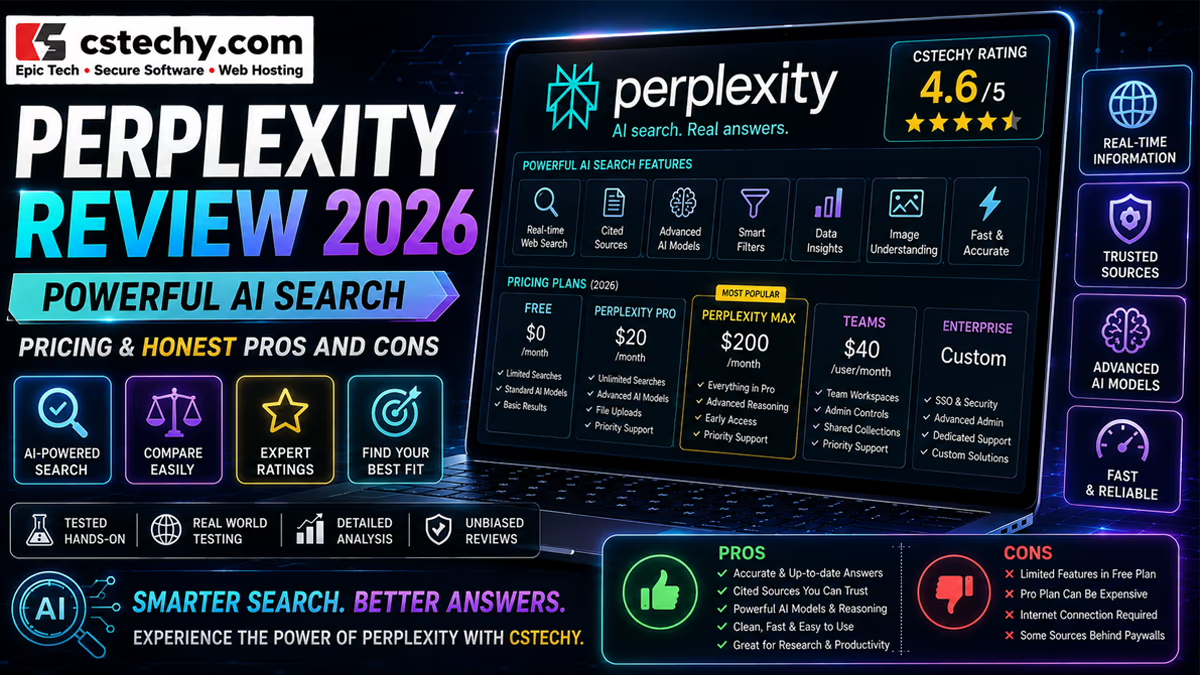
As of mid-to-late 2026, Perplexity offers six main tiers: Free, Pro, Max, a discounted Education Pro plan, and two Enterprise levels (Pro and Max), alongside a separately billed developer API. Perplexity has adjusted pricing and features more than once already in 2026, so treat the figures below as a general guide and confirm current numbers on Perplexity’s official pricing page before subscribing.
| Plan | Best For | Main Benefits | Important Consideration |
|---|---|---|---|
| Free | Occasional search and quick questions | Unlimited basic search, a small daily allotment of Pro Search and Research queries | No access to premium models or higher-tier features |
| Pro | Daily individual research use | Expanded Pro Search and Deep Research limits, access to multiple frontier models, Comet’s agentic features | Usage limits still apply, particularly for autonomous features |
| Max | Heavy research and agentic power users | Highest individual usage ceilings, Model Council, expanded Computer/Browser Agent access | Significantly more expensive than Pro — the value case depends on actually using the autonomous features |
| Education Pro | Verified students | Pro-level features at a reduced price | Requires student verification |
| Enterprise Pro / Max | Organizations needing governance | Admin controls, SSO, centralized billing; Max adds SCIM, audit logs, and higher usage ceilings | Per-seat pricing, with Max substantially pricier than Pro |
Free includes unlimited basic search with citations, plus a small daily allotment of Pro Search and Deep Research queries — genuinely usable for quick, everyday questions without needing to subscribe.
Pro, priced around $20 per month, substantially raises Pro Search and Deep Research limits, adds access to multiple premium AI models, and includes Comet’s agentic browsing features with plan-appropriate usage allowances. For most individuals using Perplexity regularly for research or fact-checking, this tends to be the plan that removes Free’s daily-limit friction.
Max, priced significantly higher (around $200 per month), is aimed at power users who want the highest usage ceilings, Model Council access, and expanded autonomous Computer/Browser Agent capacity. Given the price gap from Pro, it’s worth honestly assessing whether you’ll actually use the autonomous, background-running features enough to justify the cost — for most people, Max is primarily a capacity and automation upgrade rather than a fundamentally different feature set.
Education Pro offers Pro-level features to verified students at a meaningfully reduced price — a straightforward value pick for anyone eligible.
Enterprise Pro and Enterprise Max are per-seat plans for organizations, adding centralized billing, admin controls, and stronger data-handling commitments. Enterprise Max sits well above Enterprise Pro in price and adds governance features like SCIM provisioning and audit logs, along with substantially higher usage ceilings — organizations that specifically need those controls should budget for the Max tier rather than assuming Pro covers compliance needs.
Perplexity Free vs. Pro vs. Max
The practical differences come down to usage limits, model access, and automation. Free covers basic search and a light daily allotment of advanced queries; Pro meaningfully expands all of that and adds access to premium models and Comet’s agentic features within plan limits; Max removes most remaining friction for heavy users and adds Model Council plus the highest automation ceilings. If you’re mainly asking occasional questions, Free is a reasonable stopping point. If you’re hitting daily limits or specifically want reliable access to premium models, Pro is the natural upgrade. Max only tends to make sense once you have a clear, recurring use case for its automation and research capacity — not simply as a default “better” tier.
Perplexity Enterprise
Perplexity’s Enterprise tiers are built for organizations that need centralized administration, security controls, and predictable per-seat billing rather than individual subscriptions. Enterprise Pro covers the essentials — shared billing, admin controls, and organization-level data protections — while Enterprise Max adds heavier governance tooling (SCIM, audit logs, configurable data retention) and substantially higher usage ceilings aimed at organizations running Perplexity as core infrastructure rather than an occasional tool. Given the significant price difference between the two, organizations should map their actual compliance requirements against each tier’s specific inclusions rather than defaulting to the higher tier.
Perplexity Pros and Cons
Advantages
- Citation-based, source-transparent answers that are straightforward to verify
- Strong research and search-first design, particularly for current or fast-changing information
- Access to multiple frontier AI models in a single interface
- Comet’s free, integrated AI browsing experience
- Deep Research for genuinely accelerating early-stage research work
- Growing file and content-creation tools on paid plans
Disadvantages
- Usage limits apply even on paid tiers, particularly for autonomous features
- Max is expensive, and its value depends heavily on actually using automation features
- Citations don’t guarantee correctness — source quality and interpretation still need checking
- Less suited to long-form writing or deep coding work compared to assistants built specifically for those tasks
- Rapidly evolving product lineup makes it harder to pin down a stable feature set
- Agentic features carry real risk if permissions aren’t reviewed carefully
Perplexity Accuracy and Research Limitations
Perplexity’s search-and-cite design reduces some risk compared to a purely generative chatbot, but doesn’t eliminate error. It can misinterpret what a source says, synthesize multiple sources in a misleading way, rely on a low-quality or outdated source, or miss context a human researcher would catch. Deep Research reports should be read critically rather than treated as finished work — they compile information faster than manual research, not more reliably than a careful human reviewer.
For any conclusion that matters, open the cited sources and verify them yourself rather than relying on the synthesis alone.
Perplexity Privacy and Security
Privacy handling differs between consumer and Enterprise use, so it’s worth understanding which applies to your account. Enterprise data is generally not used for model training, and Perplexity’s enterprise agreements with upstream model providers reportedly restrict those providers from training on enterprise data as well — a different guarantee than what applies to individual consumer accounts.
Comet introduces its own considerations: certain browsing information is described as remaining local by default, though specifics depend on current settings, and autonomous Browser Agent actions involve different access than passive summarization. Review your account’s current privacy and permission settings directly, especially before using Perplexity or Comet for sensitive personal or confidential business information, rather than assuming a blanket privacy guarantee applies.
Perplexity vs. ChatGPT
These tools solve overlapping but distinct problems. Perplexity’s core strength is search-first, citation-transparent research — a real design advantage if your primary need is finding and verifying current information quickly. ChatGPT offers a broader general-purpose feature set: stronger long-form writing support, more mature image generation, voice interaction, and a wider third-party ecosystem, without the same citation-first default behavior.
For research-heavy, fact-checking-oriented work, Perplexity often has the edge. For long-form creative writing or broad everyday productivity, ChatGPT tends to be more versatile. Many users reach for both, depending on the task.
Perplexity vs. Gemini
Gemini’s biggest advantage is ecosystem depth — deep integration into Gmail, Docs, Sheets, and Android — which Perplexity doesn’t attempt to replicate. Perplexity’s advantage is a sharper focus on search, research, and source-driven answers as its core design. For Google Workspace users, Gemini’s embedded convenience is hard to match; for anyone whose primary need is fast, well-sourced research independent of any particular software ecosystem, Perplexity’s focus tends to show.
Perplexity vs. Claude
Claude tends to be stronger for sustained long-form writing, coding through Claude Code, and long-context document work, while Perplexity’s strength remains search and research synthesis with transparent sourcing. For a research-heavy task where verifying sources matters most, Perplexity is often the better starting point; for extended writing or development work, Claude’s tools are generally better suited. As with the comparisons above, testing both against your actual recurring tasks is more reliable than assuming one is universally better.
Who Should Use Perplexity?
- Students — research and source discovery, supporting rather than replacing learning
- Writers — research and fact-gathering before and during drafting
- Researchers — literature discovery, synthesis, and structured research reports
- Developers — technical research and current documentation discovery
- Businesses — competitive intelligence and market research
- Everyday users — fast, cited answers as a search-engine alternative
Who May Not Need Perplexity?
If ordinary search already meets your needs, or your AI use is occasional and general-purpose rather than research-heavy, Free — or skipping Perplexity altogether — may be sufficient. If you already rely on an AI assistant that handles research reasonably well alongside writing and other tasks, adding Perplexity specifically for its citation-first design may not be worth a second subscription unless source verification is a frequent, real need.
Is Perplexity Worth It in 2026?
Casual users: Free is often genuinely enough — fast, cited answers without a subscription.
Students: Education Pro is a strong value pick if eligible; otherwise Free covers most needs.
Writers: Useful for the research phase specifically; Pro is worth it for frequent fact-checking, though it’s not a full writing-tool replacement.
Researchers: Perplexity’s strongest use case — Pro or Max can meaningfully speed up early-stage research, provided reports are still verified against primary sources.
Developers: Useful for technical research on Free or Pro; not a substitute for a dedicated coding assistant.
Businesses: Enterprise Pro suits teams wanting shared billing and basic governance; Enterprise Max only makes sense with concrete SCIM, audit-log, or heavy-usage requirements to justify the price gap.
Final Verdict
Perplexity has grown from a focused search alternative into a genuinely broad research and browsing platform, and its citation-first design remains a real differentiator against general-purpose AI assistants — particularly for anyone who wants to verify where an answer actually came from. Comet’s shift to free access has also made its AI-native browsing experience available to essentially anyone willing to try it, without the earlier $200/month barrier.
Its limitations are the ones any research tool built on AI synthesis will share: citations don’t guarantee correctness, autonomous features carry real risk if permissions aren’t reviewed carefully, and Max’s price only pays off if you’ll actually use its automation capacity. Perplexity is genuinely useful for research-heavy, fact-checking-oriented work; it’s a less natural fit as a single do-everything assistant for long-form writing or deep development work.
CSTechy’s take: Perplexity is worth trying — the free tier costs nothing and covers a meaningful amount of everyday research and search use on its own. Pro is worth considering if you regularly need deeper research, multiple model access, or Comet’s agentic features within reasonable limits. Max is a narrower recommendation, worth it mainly for people who will genuinely lean on its automation and research capacity day to day. Because Perplexity has changed its pricing and features multiple times through 2026, confirm current details on its official pricing page before subscribing.
Frequently Asked Questions About Perplexity
1. What is Perplexity AI?
Perplexity is an AI-powered “answer engine” that searches the web, synthesizes information from multiple sources, and returns a direct, cited answer rather than a list of links. It has expanded to include Deep Research, file and content creation, and an AI-native browser called Comet.
2. Is Perplexity free?
Yes — Perplexity offers a permanent Free plan with unlimited basic search and a small daily allotment of more advanced Pro Search and Deep Research queries. Paid Pro and Max plans expand these limits and add access to premium models and features. Pricing and limits change periodically, so check Perplexity’s current pricing page before subscribing.
3. Is Perplexity better than ChatGPT?
Neither is universally better. Perplexity’s citation-first, search-driven design gives it an edge for research and fact-checking, while ChatGPT offers a broader general-purpose feature set for writing, image generation, and everyday tasks. Many users use both for different purposes.
4. What is Perplexity Pro?
Perplexity Pro is a paid individual plan, priced around $20 per month, that substantially raises Pro Search and Deep Research usage limits, adds access to multiple premium AI models, and includes Comet’s agentic browsing features within plan-specific limits.
5. What is Perplexity Max?
Perplexity Max is the highest individual consumer tier, priced significantly above Pro, offering the highest usage ceilings, Model Council (which runs a query across multiple frontier models at once), and expanded access to autonomous Computer and Browser Agent features.
6. Is Perplexity good for research?
Yes, research is arguably Perplexity’s core strength — its Deep Research mode and citation-based answers are well suited to literature discovery, market research, and synthesizing information across sources. Reports and answers should still be checked against primary sources for anything important, since AI synthesis can misinterpret or miss context.
7. Can Perplexity search the web and provide citations?
Yes — this is Perplexity’s defining feature. Answers are built from live web search and include linked citations to the sources used, which users can inspect directly. A citation shows where information came from, though it doesn’t by itself guarantee the interpretation is correct.
8. What is the Perplexity Comet browser?
Comet is Perplexity’s Chromium-based AI-native browser, free since March 2026 across Windows, macOS, iOS, and Android. It integrates Perplexity’s search and citation-based answers directly into browsing, with an in-browser assistant that can summarize pages and, on paid plans, take autonomous actions within usage limits.
9. Is Perplexity worth paying for in 2026?
It depends on your usage. Occasional users are often well served by Free. Anyone doing regular research, needing multiple premium AI models, or relying on Comet’s agentic features is likely to find Pro worthwhile, while Max is a narrower fit for heavy users who will actually use its automation and research capacity — compare your actual usage against current plan limits before subscribing.