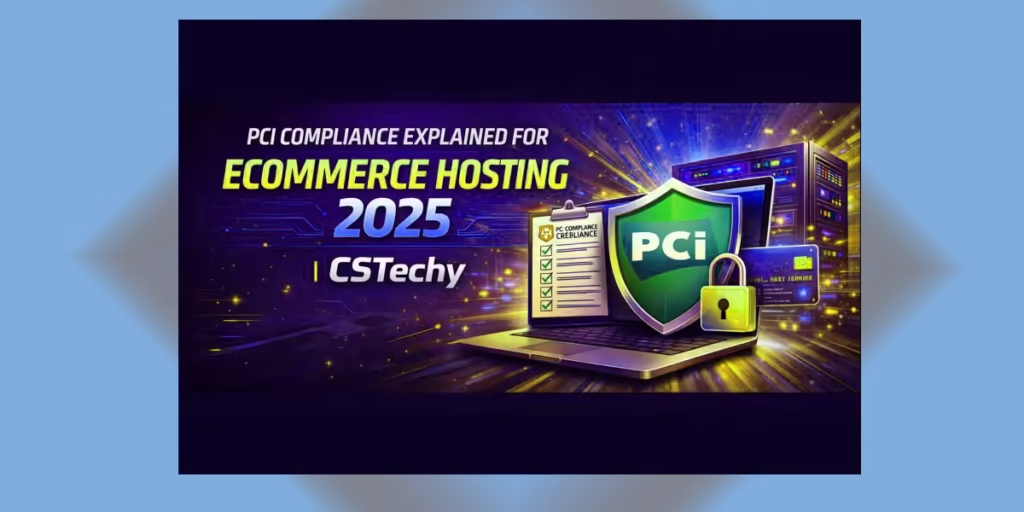
PCI Compliance Explained for Ecommerce Hosting (2025) | CSTechy
PCI compliance explained for ecommerce hosting is no longer optional in 2025. If your online store accepts card payments — debit, credit, UPI-linked cards, or international cards — you must follow PCI DSS rules. Ignoring PCI compliance can lead to heavy fines, payment gateway suspension, data breaches, and total loss of customer trust.
PCI compliance is a critical requirement for ecommerce stores handling card payments, but its effectiveness depends heavily on the hosting environment. To understand how security standards, server configuration, and hosting choices work together to protect transactions, refer to our secure ecommerce hosting guide , which explains payment security and hosting best practices in detail.
In this CSTechy guide, we’ll break down PCI compliance in simple, real-world ecommerce language. No legal jargon. No confusion. Just clear answers on what PCI DSS is, why hosting plays a critical role, and how you can stay compliant without spending a fortune.
What Is PCI Compliance? (Simple Explanation)
PCI DSS (Payment Card Industry Data Security Standard) is a global security standard created by Visa, MasterCard, American Express, Discover, and JCB.
Its goal is simple:
- Protect cardholder data
- Prevent card fraud
- Secure online payment environments
If your ecommerce website stores, processes, or transmits card data — even for a second — PCI compliance applies to you.
Why PCI Compliance Matters for Ecommerce Hosting Matters ?
Many store owners wrongly believe PCI compliance is only about payment gateways. In reality, your hosting environment plays a massive role.
- Your server security affects data safety
- Outdated hosting software increases breach risk
- Shared hosting can expose vulnerabilities
- Improper server isolation breaks PCI rules
What Happens If You Ignore PCI compliance explained for ecommerce hosting?
- ₹50,000+ monthly fines from payment networks
- Payment gateway account suspension
- Chargeback penalties
- Loss of customer trust
- Legal liability after data breaches
PCI compliance explained for ecommerce hosting (Levels Explained)/h2>
PCI DSS defines 4 merchant levels based on annual transaction volume:
| Level | Transactions / Year | Who It Applies To |
|---|---|---|
| Level 1 | 6M+ | Large ecommerce brands |
| Level 2 | 1M–6M | Growing ecommerce stores |
| Level 3 | 20k–1M | Mid-size online stores |
| Level 4 | <20k | Small & startup stores |
Most CSTechy readers fall under Level 4 — but compliance is still mandatory.
PCI compliance explained for ecommerce hosting, Requirements (12 Core Rules)
PCI DSS is built on 12 security requirements. Here’s what actually matters for ecommerce hosting:
- Secure network & firewall configuration
- Do not use default passwords
- Encrypt cardholder data
- Use SSL / HTTPS everywhere
- Maintain secure systems & updates
- Restrict access to data
- Unique IDs for admin access
- Regular vulnerability scanning
- Monitor & test networks
- Strong security policy
How Ecommerce Hosting Affects PCI Compliance
1️⃣ Shared Hosting (High Risk)
Shared hosting places multiple websites on the same server. One vulnerable site can compromise others — a PCI red flag.
2️⃣ VPS Hosting (Better Control)
VPS offers isolation, custom firewalls, and better compliance control. Suitable for serious ecommerce stores.
3️⃣ Cloud Hosting (Best Choice)
Cloud hosting provides scalability, server isolation, automatic updates, and security layers — ideal for PCI compliance.
PCI compliance explained for ecommerce hosting & Payment Gateways (Important Truth)
Using gateways like Razorpay, Stripe, PayPal, or Cashfree reduces PCI burden — but does NOT eliminate it.
- You still need HTTPS
- Your site must be malware-free
- Admin panels must be secure
- Server vulnerabilities still matter
❌ False. Hosting security is still your responsibility.
PCI compliance explained for ecommerce hosting(Checklist)in 2025 essential
- HTTPS with valid SSL
- Latest PHP & server software
- Web Application Firewall (WAF)
- DDoS protection
- Regular malware scans
- Secure admin access (2FA)
- Automated backups
- Limited server access
Does WooCommerce Need PCI Compliance?
Yes. WooCommerce stores are fully responsible for PCI compliance because WordPress is self-hosted.
CSTechy Recommendation:
- Use cloud hosting
- Offload payments to gateways
- Never store card data
- Use security plugins + server firewalls
PCI Compliance for Shopify vs WooCommerce
| Feature | Shopify | WooCommerce |
|---|---|---|
| Hosting Managed | Yes | No |
| PCI Responsibility | Mostly Shopify | Store Owner |
| Server Control | Limited | Full |
| Compliance Effort | Low | Medium–High |
How to Become PCI Compliant (Step-by-Step)
- Choose PCI-friendly hosting
- Enable HTTPS everywhere
- Use secure payment gateways
- Update CMS, plugins & themes
- Install firewall & malware scanner
- Restrict admin access
- Complete SAQ (Self-Assessment Questionnaire)
FAQs PCI Compliance Explained for Ecommerce Hosting | CSTechy
Q1. Is PCI compliance mandatory for ecommerce websites?
A: Yes. Any ecommerce site accepting card payments must follow PCI DSS rules, even small stores.
Q2. Does using Stripe, Razorpay, or PayPal make my site PCI compliant?
A: No. Payment gateways reduce risk, but your hosting security and SSL are still required.
Q3. Is shared hosting PCI compliant for ecommerce?
A: Usually no. Shared hosting increases security risks and often fails PCI standards.
Q4. Do WooCommerce stores need PCI compliance?
A: Yes. WooCommerce is self-hosted, so PCI compliance is the store owner’s responsibility.
Is shared hosting PCI compliant for ecommerce?

A: Cloud or VPS hosting with isolation, firewall, and regular updates is best.
Final Verdict: PCI Compliance Is Non-Negotiable
PCI compliance explained for ecommerce hosting comes down to one truth: security builds trust, trust builds sales.
With the right hosting, secure payment setup, and basic best practices, PCI compliance is achievable even for small stores. CSTechy strongly recommends investing in secure cloud hosting from day one — it saves money, stress, and reputation long-term.
CSTechy Pro Advice: If you plan to scale ecommerce seriously, treat PCI compliance as a business asset — not a burden.