VPS vs Cloud for Ecommerce Sites (2025) | CSTechy Guide
Choosing between VPS vs Cloud for ecommerce sites (2025) can directly impact your store’s speed, uptime, security, and ability to handle traffic spikes. This CSTechy guide explains the differences in simple language so you can choose the right hosting architecture for your online business.
In 2025, ecommerce hosting is no longer about “just staying online.” Customers expect instant loading pages, smooth checkout, and zero errors during payments. If your hosting fails during peak traffic, you lose money instantly.
This article will help you understand:
- What VPS and Cloud hosting really mean
- How each performs for ecommerce stores
- Which is cheaper long-term
- Which scales better during traffic spikes
- Which CSTechy recommends for different store sizes
What Is VPS Hosting for Ecommerce Sites?
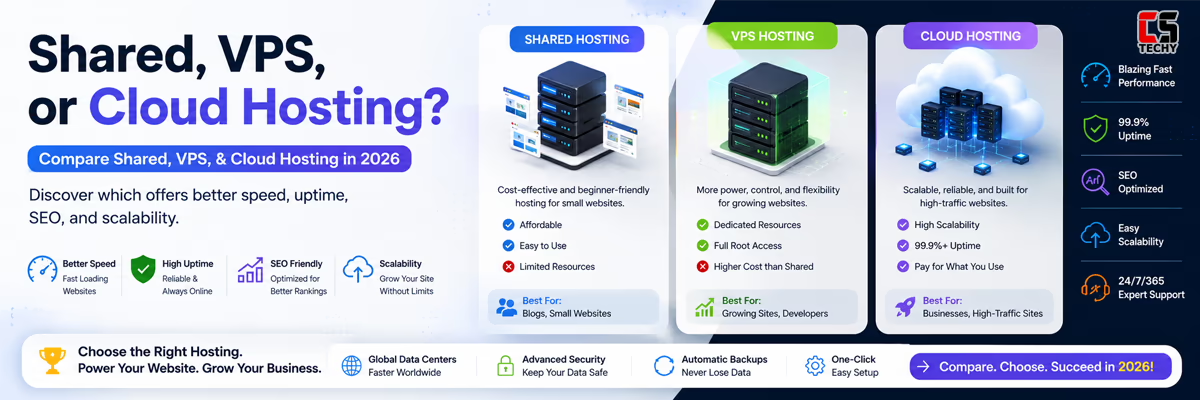
VPS (Virtual Private Server) hosting divides a physical server into multiple virtual servers. Each VPS gets its own allocated CPU, RAM, and storage. For ecommerce, this means better performance and stability than shared hosting.
Key VPS Hosting Characteristics
- Dedicated resources (CPU & RAM)
- More control than shared hosting
- Predictable performance
- Fixed server limits
VPS hosting is often chosen by ecommerce stores that have outgrown shared hosting but are not yet ready for cloud infrastructure.
What Is Cloud Hosting for Ecommerce Sites?
Cloud hosting runs your ecommerce site on a network of connected servers instead of a single machine. If one server fails or traffic spikes, another server automatically takes over.
Key Cloud Hosting Characteristics
- Multiple server architecture
- Automatic scalability
- High uptime & fault tolerance
- Pay-as-you-grow pricing models
Key Advantage: Cloud hosting is designed for growth, traffic spikes, and high availability.
Why VPS vs Cloud for Ecommerce Sites Matters in 2025
Ecommerce traffic is unpredictable. Flash sales, influencer promotions, festive sales, and ads can cause sudden spikes. The wrong hosting type can crash your store during your best sales opportunity.
- Slow hosting = cart abandonment
- Downtime = lost revenue
- Poor scalability = failed campaigns
That’s why choosing between VPS vs Cloud for ecommerce sites (2025) is a strategic business decision, not just a technical one.
Performance Comparison: VPS vs Cloud for Ecommerce (2025)
VPS Performance
- Stable and predictable speeds
- Limited by server hardware
- Manual upgrades required
VPS hosting performs well for medium-traffic ecommerce stores with consistent visitor patterns.
Cloud Performance
- Scales instantly with traffic
- Handles peak loads smoothly
- Optimized for high availability
Verdict: Cloud hosting wins for performance under unpredictable traffic loads.
Scalability: Which Handles Growth Better?
Scalability is the biggest difference between VPS and Cloud hosting.
- VPS: Vertical scaling (upgrade plan manually)
- Cloud: Horizontal + vertical scaling automatically
For ecommerce sites planning seasonal sales, flash discounts, or long-term growth, cloud hosting provides far more flexibility.
Security Comparison: VPS vs Cloud for Ecommerce
Security is critical for ecommerce websites that process payments and store customer data.
VPS Security
- Isolated server environment
- User responsible for security setup
- Firewall & updates needed
Cloud Security
- Multi-layer cloud firewalls
- Automatic OS-level patches
- DDoS protection
Verdict: Cloud hosting offers stronger built-in security for ecommerce.
Uptime & Reliability
Uptime affects SEO, trust, and revenue.
- VPS: Depends on single server health
- Cloud: High availability with redundancy
If uptime is critical (and it always is for ecommerce), cloud hosting has a clear advantage.
Cost Comparison: VPS vs Cloud for Ecommerce Sites (2025)
Cost depends on traffic, scale, and usage.
VPS Cost Structure
- Fixed monthly pricing
- Cheaper for steady traffic
- Extra cost for upgrades
Cloud Cost Structure
- Pay-as-you-use pricing
- Higher cost during high traffic
- Better ROI for growth
CSTechy Insight: VPS is cheaper short-term. Cloud is cheaper long-term when revenue grows.
Ease of Management
- VPS: Requires server management skills
- Cloud: Easier with managed cloud hosting
Managed cloud platforms remove complexity while delivering top-tier performance.
VPS vs Cloud for Ecommerce Sites – Comparison Table
| Feature | VPS | Cloud |
|---|---|---|
| Performance | Good | Excellent |
| Scalability | Limited | Automatic |
| Security | Strong (manual) | Advanced (built-in) |
| Uptime | Good | Very High |
| Cost Model | Fixed | Usage-based |
| Best For | Stable traffic stores | Growing & high-traffic stores |
FAQs – VPS vs Cloud for Ecommerce Sites (2025)
Is VPS enough for ecommerce?

Yes, for medium stores with stable traffic.
Is cloud hosting better for sales events?

Yes, cloud handles traffic spikes without crashing.
Which is better for SEO?

Cloud hosting often performs better due to speed and uptime.
Can I move from VPS to cloud later?

Yes, most providers support easy migration.
Which is safer?

Yes, most providers support easy migration.
Final Verdict – VPS vs Cloud for Ecommerce Sites (2025)
The decision between VPS vs Cloud for ecommerce sites (2025) depends on your business stage:
- Choose VPS if you have stable traffic and want predictable costs.
- Choose Cloud if you want scalability, performance, and future-proof hosting.
VPS = Stability & control. Cloud = Growth, speed & scalability.
— CSTechy Trusted Guide