What Can I Use a VPS For? 12 Powerful Uses | CSTechy
If you’ve been around tech for even a short time, you’ve probably heard of a VPS (Virtual Private Server). It’s often described as more powerful than shared hosting and cheaper than a dedicated server—but that doesn’t explain what you can actually do with it.
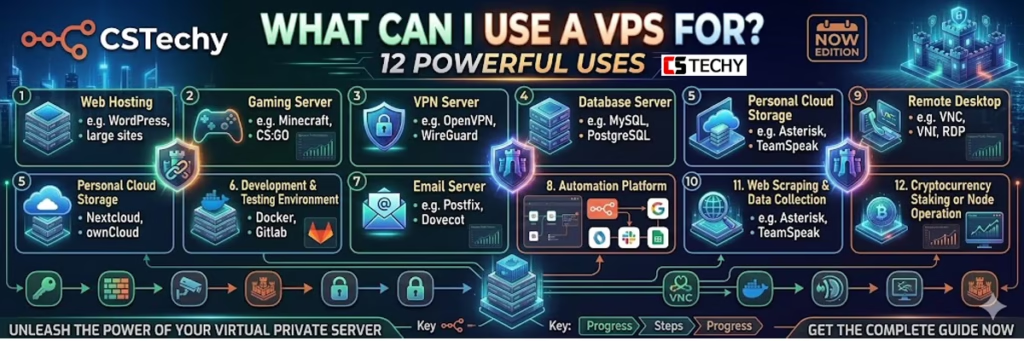
So, what can I use a VPS for? In simple terms, a VPS lets you run websites, automation tools like n8n, affiliate or AdSense projects, and even game servers without limitations. You can also use it for private VPNs, cloud storage, data scraping, or testing apps safely.
👉 Read the complete n8n self-hosting guide on CSTechy to unlock the full power of VPS automation.
The real advantage is control—you’re not restricted like shared hosting. You can install anything, scale performance, and run projects 24/7, making a VPS perfect for serious bloggers, developers, and online businesses.
1. The Self-Hosted Automation Hub (n8n & OpenClaw)
This is the #1 reason CSTECHY readers buy a VPS in 2026. Tools like Zapier and Make.com work well—until your usage scales. Once you hit 50,000 tasks a month, costs can explode to $500 or more. That’s where the real answer to what can I use a VPS for becomes clear: cost control and unlimited automation.
By hosting n8n on your own VPS, you can run unlimited workflows for a fixed monthly price—often cheaper than a single SaaS subscription.
In 2026, the shift is toward “Agentic Automation.” By combining tools like OpenClaw or AutoGPT with your n8n setup, you can build intelligent systems that don’t just move data—they actually make decisions. Imagine a bot that monitors your emails, researches the sender, and drafts a personalized reply automatically, running 24/7 on your VPS.
This is where a VPS stops being just hosting—and becomes your personal automation engine.
2. Deploying & Fine-Tuning Your Own AI Models
“Big Tech” AI is powerful, but it often comes with high costs and privacy concerns. That’s where the real answer to what can I use a VPS for becomes even more valuable in 2026.
Smart developers are now using VPS servers with high-RAM setups or GPU acceleration to run local Large Language Models (LLMs) like Llama 3.5 or Mistral—without relying on expensive cloud APIs.
With tools like Ollama installed on your VPS, you can run a completely private AI that understands your business data without sending anything to external servers. This means better security, lower costs, and full control over your AI environment.
You can even fine-tune these models using your own documents, turning your VPS into a powerful AI engine. Imagine building a customer support bot that truly understands your products, answers queries instantly, and runs 24/7—all hosted on your own VPS.
3. Hosting High-Performance Game Servers
Tired of lag on public servers? In 2026, the gaming community has shifted heavily toward Private VPS Hosting. Whether it’s the latest Minecraft update, a custom GTA V (FiveM) roleplay world, or a competitive CS:GO/CS2 arena, a VPS gives you total control.
A Hostinger KVM 4 plan (with 16GB RAM) can easily host 50+ players with sub-20ms latency. You can install custom mods, set your own rules, and even monetize your server by selling “VIP” slots or custom skins.
4. Algorithmic Trading & Forex 24/7
In the world of Forex and Crypto trading, even a 1-second delay can mean profit or loss. That’s exactly where the answer to what can I use a VPS for becomes critical. Running trading bots on a home PC is risky—power cuts, internet drops, or system crashes can prevent stop-loss orders from executing on time.
Professional traders use a VPS to run MetaTrader or custom Python bots 24/7 with stable performance and near-zero latency. Since a VPS is always online in a secure data center, your trades execute reliably without interruptions.
Platforms like Bluehost VPS are popular for their high-availability infrastructure, making them ideal for serious trading setups.
5. Building Your Own Private VPN
Commercial VPNs in 2026 face issues like data logging and blocked shared IPs—this is where what can I use a VPS for becomes highly practical. By setting up WireGuard or OpenVPN on your VPS, you create a fully private and secure VPN.
You get a dedicated static IP that only you control, making it ideal for secure remote access or bypassing geo-restrictions. It’s a powerful example of what can I use a VPS for without relying on slow or untrusted VPN services.
Unlike free VPNs, your VPS-based setup delivers better speed, privacy, and reliability—giving you complete control over your online security.
6. Ditching Google Drive with Self-Hosted Cloud Storage
Privacy-conscious teams are moving their data to Nextcloud or OwnCloud hosted on a VPS. This gives you a “Dropbox-style” interface where you can sync files, photos, and calendars across all your devices.
The best part? You aren’t paying a monthly “storage tax.” If you have a 400GB NVMe drive on your Namecheap VPS, all 400GB belongs to you. You can even set up “End-to-End Encryption” so that even the hosting provider can’t see your files.
7. What Can I Use a VPS For? The Ultimate Sandbox for Developers
Every developer knows the fear of “breaking the production site.” A VPS allows you to create a **Staging Environment** that is a perfect mirror of your live site.
You can test a new PHP version, a risky WordPress plugin, or a complex database migration on the VPS first. If it breaks, you just click “Reinstall OS” and start over in 60 seconds. This “Sandboxing” capability is why a VPS is the best place to improve your coding and DevOps skills.
8. Hosting a Private, Secure Email Server
If you are tired of Gmail reading your messages to serve you ads, you can host your own mail server using Mail-in-a-Box or iRedMail.
A VPS mail server gives you total privacy and unlimited email accounts for your domain. When paired with a Dedicated IP from a provider like MilesWeb, your “Deliverability” score will be higher than ever, ensuring your business emails actually reach the inbox.
9. Launching Your Own SaaS (Software as a Service)
In 2026, the Micro-SaaS trend is booming, and it clearly shows what can I use a VPS for beyond basic hosting. You can launch simple apps like AI tools or niche CRMs without relying on expensive cloud platforms.
With a $10/month VPS, you can deploy your app using Docker and Portainer, keeping everything lightweight and scalable. This is another powerful example of what can I use a VPS for when building real products.
As your users grow, you can easily upgrade RAM and CPU from your hosting dashboard without downtime. It’s one of the most cost-effective ways to launch and scale a tech startup in 2026.
10. A “Fortress” for Remote Backups
Never keep your backups on the same server as your website. Many savvy users use a secondary, low-cost “Storage VPS” (like those from Namecheap) specifically for Off-site Backups.
You can set up a daily cron job to automatically sync your website files and databases to a remote server—another smart answer to what can I use a VPS for. In 2026, with ransomware threats rising daily,
Having an isolated backup on a separate VPS is one of the safest ways to protect your data and ensure peace of mind.The 2026 Hardware Check: Why “Which VPS” Matters
Not all of these use cases will run smoothly on a basic plan—that’s another key part of understanding what can I use a VPS for. In 2026, choosing the right VPS configuration depends on your workload, so here’s a simple rule of thumb:
- For n8n/Automation: You need high I/O. Go for NVMe storage.
- For Gaming/AI: You need raw CPU threads and RAM. Don’t settle for less than 8GB.
- For VPN/Surfing: You need Network Throughput. Look for 1Gbps ports.
Conclusion: Your VPS, Your Rules
The question isn’t just “What can I use a VPS for?”—it’s “What should I build first?” Whether you are looking to save money on SaaS, boost your gaming experience, or secure your digital life, a VPS is the foundation.
If you are ready to take the first step, check out our guide on How to Connect to Your VPS to start building your 2026 project today!
What Can I Use a VPS For? FAQ:
1. What can a VPS be used for?

A VPS can be used for hosting websites, running automation tools like n8n, creating game servers, hosting applications, running trading bots, VPN servers, and development environments.
2. Is a VPS good for running automation tools?

Yes. A VPS is ideal for automation platforms because it provides dedicated resources, full server control, and 24/7 uptime, allowing workflows and scripts to run continuously.
3. Can beginners use a VPS server?

Yes, but beginners may need basic knowledge of Linux commands, SSH access, and server configuration. Many providers also offer control panels that make VPS management easier.
4. Is VPS hosting better than shared hosting?

In most cases, yes. VPS hosting provides better performance, dedicated resources, improved security, and more flexibility compared to shared hosting.
5. Do developers use VPS for testing applications?

Yes. Developers often use VPS servers to test applications, run staging environments, deploy APIs, and build development servers before launching projects publicly.